

You’re closing local SEO deals but drowning in delivery. You can sell the service, but you can’t scale the work without hiring, training, and managing a full team.
That’s not a sales problem. It’s a fulfillment problem.
White label local SEO solves this by giving you infrastructure, not just outsourced tasks. You sell under your brand, a specialized provider executes behind the scenes, and your clients never know the difference.
But most guides treat white label like a simple vendor relationship. They focus on “what it is” instead of “how it actually works.” They skip the operational reality agencies need to understand before committing.
This guide goes deeper. You’ll learn exactly how white label local SEO operates day-to-day, how to evaluate providers without relying on marketing claims, and what separates reliable infrastructure from vendors who disappear when things get hard.
By the end, you’ll know whether white label fits your agency, what to look for in a provider, and how to avoid the mistakes that cost agencies clients and credibility.
Pro Tip: Most agencies wait until they’re overwhelmed to explore white label. The best time to evaluate it is before you turn down your next local SEO opportunity.
What White Label Local SEO Actually Means (And What It Doesn’t)
The Three-Party Model Explained
White label local SEO involves three parties, not two. Understanding who owns what prevents confusion later.
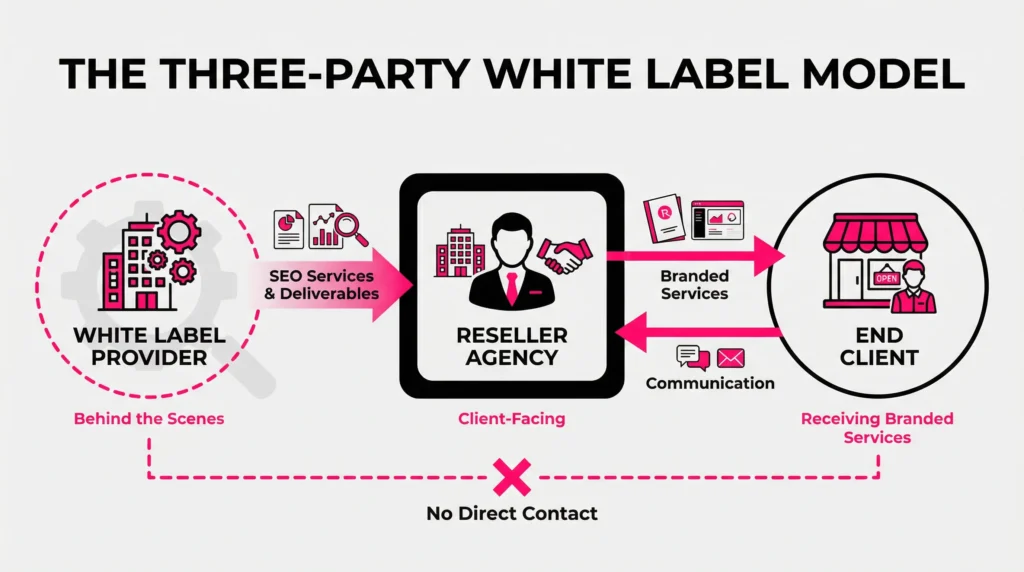
The three parties:
- White label provider – The invisible team doing the actual SEO work. They have the tools, processes, and specialists.
- Reseller agency (you) – The agency selling local SEO services under your brand. You own the client relationship and set pricing.
- End client – The local business paying for SEO services. They believe your agency is doing all the work.
Here’s what makes it “white label”: the provider operates completely invisibly. Your branding appears on every report, dashboard, and deliverable. The client never sees the provider’s name, logo, or contact information.
You control the relationship. You handle all client communication, contract negotiations, and strategic decisions. The provider executes your instructions and delivers results you can present as your own work.
Did You Know? The term “white label” comes from vinyl records. Promotional copies sent to DJs had blank white labels so they could be rebranded by any distributor. Same concept—high-quality product, your branding.
The provider isn’t a subcontractor in the traditional sense. They’re infrastructure you plug into, like using Stripe for payments or AWS for hosting. The client doesn’t need to know your tech stack.
Risk stays with you. If the provider underdelivers, your client blames your agency. That’s why provider selection matters more than most agencies realize upfront.
White Label vs Traditional Outsourcing: Why the Difference Matters
Most agencies confuse white label with traditional outsourcing. They’re fundamentally different business models with different implications for your brand.
Traditional outsourcing:
- Client knows you’re using a third party
- Provider’s name often appears in communications
- You’re managing a vendor relationship
- Client may communicate directly with the provider
White label:
- Client believes your agency is doing the work
- Provider stays completely invisible
- You’re leveraging infrastructure, not managing vendors
- All communication flows through your agency
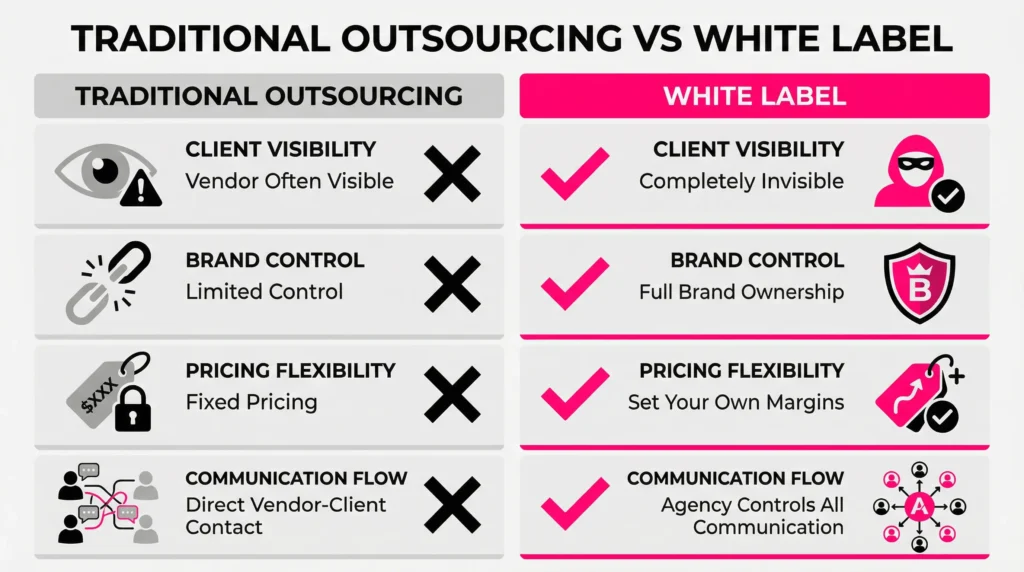
The practical difference shows up in pricing and positioning. With traditional outsourcing, you’re just marking up someone else’s visible work. Clients shop around and compare prices.
With white label, you’re selling your agency’s service. You set your own pricing based on your positioning, not the provider’s rates. Your 50% margin isn’t visible to the client.
Brand protection is stronger with white label. The provider has no incentive to contact your clients or compete for their business. They make money by keeping you successful, not by replacing you.
Pro Tip: If a “white label” provider requires you to disclose their involvement to clients, they’re not actually white label. They’re just traditional outsourcing with optional branding.
Traditional outsourcing works fine when clients understand they’re getting specialized expertise. White label works when you want to own the entire service offering under your brand.
White Label vs Offshore SEO: Understanding the Real Tradeoffs
“Offshore” and “white label” aren’t the same thing, but many agencies use them interchangeably. Understanding the difference prevents expensive mistakes.
Offshore means the work happens outside your country—often in lower-cost regions. White label means the provider operates invisibly under your brand. You can have offshore white label, US-based white label, or offshore traditional outsourcing.
Where offshore typically struggles for local SEO:
- Time zone gaps – Client needs something urgent at 2pm EST. Your offshore team is asleep. Problems compound.
- Local market knowledge – Optimizing for “plumber near me” in Austin, Texas requires understanding Austin, not just SEO theory.
- Language and communication – Nuance matters in client communication. Accents, phrasing, and cultural context affect trust.
- Quality inconsistency – Not because offshore teams lack skills, but because management oversight across 12-hour time zones is harder.
Some agencies successfully use offshore teams for defined, repeatable tasks like citation building or reporting. The work is documented, qa-able, and doesn’t require real-time communication.
But when a client calls upset about their Google Business Profile, you need someone who can respond in hours, not days. You need a team that understands why “near me” searches matter for local businesses.
Expert Pick: US/UK/AU-based white label providers cost 40-60% more than offshore alternatives, but agency retention proves the premium pays off. Search Visibility Masters serves 50+ agencies specifically because communication and local market understanding aren’t negotiable.
The cheapest option rarely ends up being the most profitable. Calculate client lifetime value, not just monthly cost. One lost client from poor service quality erases months of offshore “savings.”
Offshore makes sense when you have tight margins, high volume, and can accept inconsistency. White label (especially domestic) makes sense when client retention matters more than minimizing costs.
How White Label Local SEO Actually Operates Behind the Scenes
The Complete Workflow from Sale to Delivery
Most guides explain what white label is. Few explain how it actually works day-to-day. Here’s the complete operational workflow from closed deal to ongoing delivery.
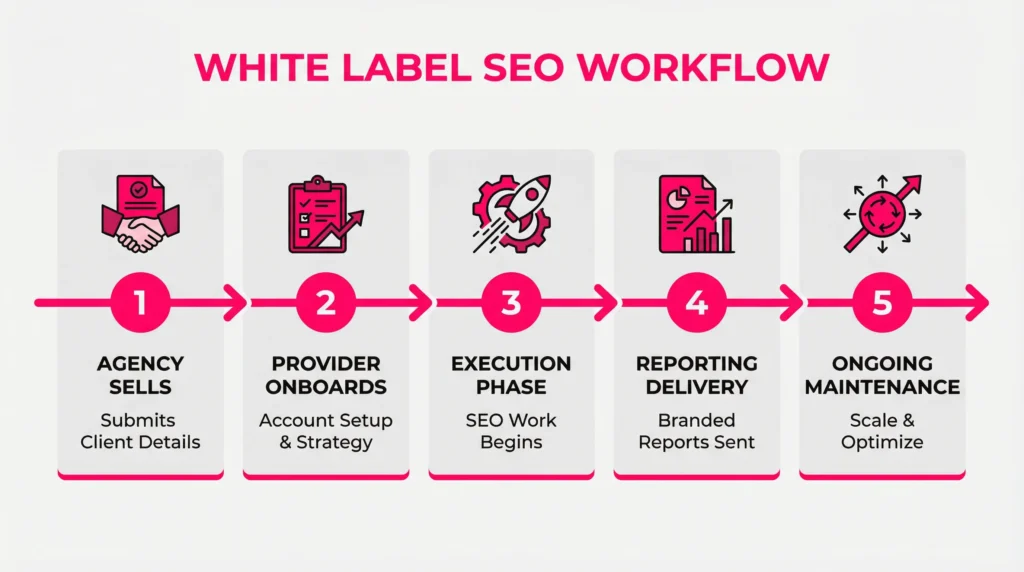
Step 1: Agency sells, submits client details
You close a local SEO client. They sign your contract, pay your invoice, and expect your agency to deliver. You log into your white label provider’s system and submit the client details: business name, website, location, target keywords, current access credentials.
This handoff takes 15-30 minutes if the provider has a proper intake system. No back-and-forth emails. No unclear requirements. Just structured data entry.
Step 2: Provider onboards (timeline, requirements, handoff protocols)
The provider receives your submission and begins onboarding. A proper provider assigns a dedicated account manager and starts work within 24-48 hours, not “sometime next week.”
They’ll audit the client’s current local SEO status. This includes Google Business Profile setup, citation consistency, on-page optimization, and existing backlinks. This baseline establishes where the client starts and what work needs priority.
Onboarding typically takes 5-7 business days. Rush providers who promise “immediate results” usually skip critical audit work and cause problems later.
Step 3: Execution phase (who does what, communication cadence)
The provider executes the actual work: optimizing the Google Business Profile, building and cleaning up citations, creating local content, building local links, monitoring reviews.
You’re not managing tasks. You’re not assigning work tickets. The provider follows their documented process for every client. Standardization is the point. Consistent quality without your involvement.
Communication cadence matters here. Weekly internal updates keep you informed. Monthly reports give you client-facing deliverables. Emergency protocols exist for urgent issues like negative reviews or Google Business Profile suspensions.
Pro Tip: Good providers send updates before you ask. If you’re constantly chasing status reports, you have a communication problem that won’t improve over time.
Step 4: Reporting delivery (branding, format, client-facing process)
Month one closes. The provider generates a comprehensive report showing all completed work, ranking changes, traffic increases, and lead attribution where trackable.
This report arrives with your agency’s logo, colors, and branding. Your domain appears in the header, not theirs. The formatting matches your other client deliverables so nothing looks outsourced.
You review the report briefly (5-10 minutes), then forward it to your client. Some agencies schedule calls to walk through results. Others just email the report with brief context. Your choice.
Step 5: Ongoing maintenance and scale
Month two begins automatically. The provider continues the work: posting to Google Business Profile, monitoring citations, building links, tracking rankings, managing reviews.
You’re not involved in daily operations. That’s the infrastructure advantage. You can onboard client #2, #3, or #10 without changing your workload. The provider’s capacity scales with your growth.
This repeats monthly. The relationship either stabilizes into reliable infrastructure, or problems emerge that reveal you chose the wrong provider. You’ll know within 90 days.
Client Communication: Who Talks to Whom (And When)
The communication structure makes or breaks white label relationships. Clarity about who talks to whom prevents disasters.
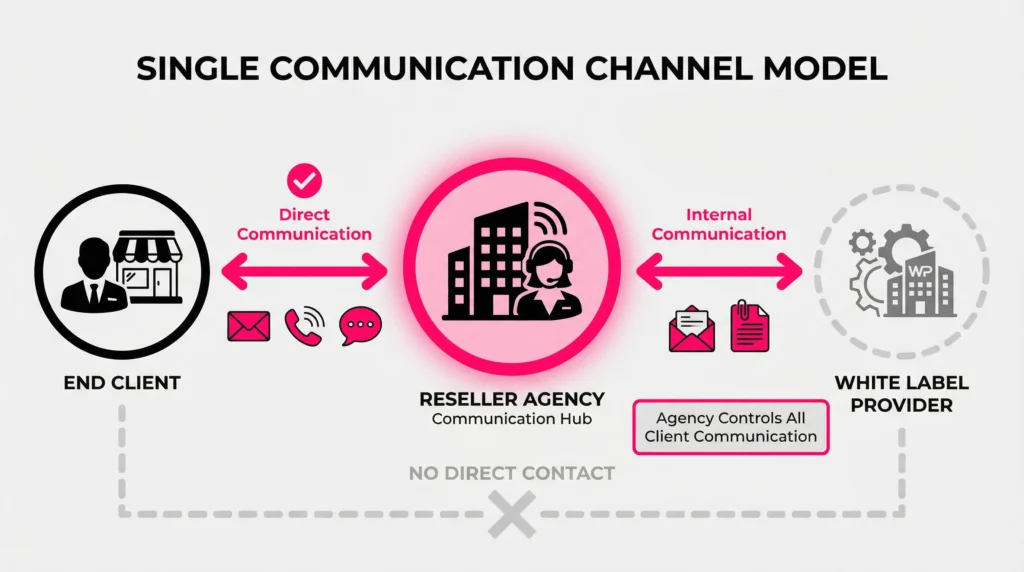
The invisible provider model:
Your client emails or calls you with questions, concerns, or requests. You field everything. The provider never contacts your client directly. Not for clarification, not for urgent issues, not ever.
If the provider needs information from the client (login credentials, specific business details, clarification on services offered), they ask you. You ask your client. You relay the answer back. One communication channel, no exceptions.
This sounds inefficient. It’s actually protection. The moment a provider contacts your client directly, your brand control disappears. Clients start wondering who’s really doing the work.
How reporting stays branded:
Reports come to you first, never directly to the client. You review them for quality, accuracy, and brand consistency before forwarding.
Some agencies add their own executive summary or strategic recommendations on top of the provider’s tactical report. Others forward as-is. Both work as long as your branding is consistent.
The client sees your email signature, your logo on the report header, your agency name everywhere. They call you with questions. You’re the expert in their eyes.
Did You Know? The Federal Trade Commission requires that agencies disclose material relationships that affect endorsements or testimonials, but white label fulfillment doesn’t trigger this requirement because you’re not endorsing the provider. You’re delivering your own service using infrastructure.
Emergency protocols when issues arise:
Your client’s Google Business Profile gets suspended. Their rankings drop suddenly. A competitor posts fake negative reviews. Urgent issues happen in local SEO.
Your provider should have documented emergency response protocols. Who to contact, response time commitments, escalation paths. If they say “email support@provider.com and we’ll get back to you,” find a different provider.
The best providers give you a direct phone number or Slack channel for emergencies. Response times should be measured in hours, not days.
Managing client questions about who’s doing the work:
Most clients never ask. They assume you have a team. But occasionally a sophisticated client will ask directly: “Who on your team handles this work?”
Honesty without over-sharing works best. “We have local SEO specialists on our team who focus exclusively on this work” is accurate. You do have specialists. They’re just infrastructure, not employees.
Avoid: “We outsource to a partner” or “We use a white label provider.” That language creates doubt about your capability and control.
If a client demands to know employee names, meet your team, or insists on direct contact, white label probably won’t work for that relationship. Some clients require full transparency. That’s fine. Just price accordingly.
Pro Tip: The agencies that struggle with white label are the ones who feel guilty about the model. If you frame it as infrastructure (like using HubSpot for CRM), the guilt disappears. You’re not hiding anything. You’re using smart systems to deliver results.
What “White Label” Means for Your Brand Protection
Brand protection isn’t about secrecy. It’s about maintaining client trust while using infrastructure that makes your business viable.
How providers stay invisible:
Legitimate white label providers sign non-disclosure agreements and non-compete clauses. They legally commit to never contacting your clients or using your client relationships for their own business development.
Their systems are designed for invisibility. Their email domain never appears in client communications. Their branding never shows up in reports. Their team never introduces themselves to your clients.
If you ever discover your white label provider contacted your client directly (even with good intentions), end the relationship immediately. That’s a foundational breach of trust.
Report branding and customization:
You provide your logo, brand colors, and any specific formatting requirements during onboarding. The provider templates everything to match your brand standards.
Every report generated for your clients uses your template. Some providers offer multiple templates so agencies can customize per client or service tier.
Advanced providers let you add custom sections: your agency’s strategic recommendations, upsell offers, or educational content specific to your positioning.
No contact with your clients (how this is enforced):
The provider’s contract should explicitly prohibit client contact. But contracts don’t prevent mistakes. Systems do.
Ask providers: “How do you technically prevent your team from accidentally emailing my clients?” The best answer involves separate systems, access controls, and training protocols that make accidental contact nearly impossible.
Some providers use ticket systems where they can’t even see your client’s email address. Just a ticket number. Others have strict policies backed by employee training and monitoring.
What happens if a client discovers the arrangement:
Despite best practices, discovery occasionally happens. A client searches the provider’s domain from a report metadata tag. An employee accidentally CCs the wrong email. The truth emerges.
Outcome depends entirely on your relationship strength. If you’ve been delivering consistent results and maintaining good communication, most clients don’t care. They’re buying outcomes, not your internal operations.
Frame it calmly: “We use specialized infrastructure for local SEO execution, similar to how we use [other SaaS tools]. This lets us deliver results faster and more reliably than building everything in-house.”
If the client reacts negatively and demands to leave, let them go gracefully. That client was never going to be satisfied long-term regardless of your operations.
Expert Pick: Search Visibility Masters has operated as white label infrastructure for 50+ agencies since 2017 with zero instances of client poaching or brand compromise. That track record matters more than any contract language.
The agencies that succeed with white label treat it like infrastructure: HubSpot, AWS, Stripe. Not like a dirty secret. Confidence in your model translates to client confidence in your capability.
Why Agencies Use White Label Local SEO (The Real Reasons, Not Marketing Copy)
The Fulfillment Bottleneck Problem
Most agencies don’t have a sales problem. They have a delivery problem. You can close local SEO deals all day, but you can’t scale the work without breaking your operations.
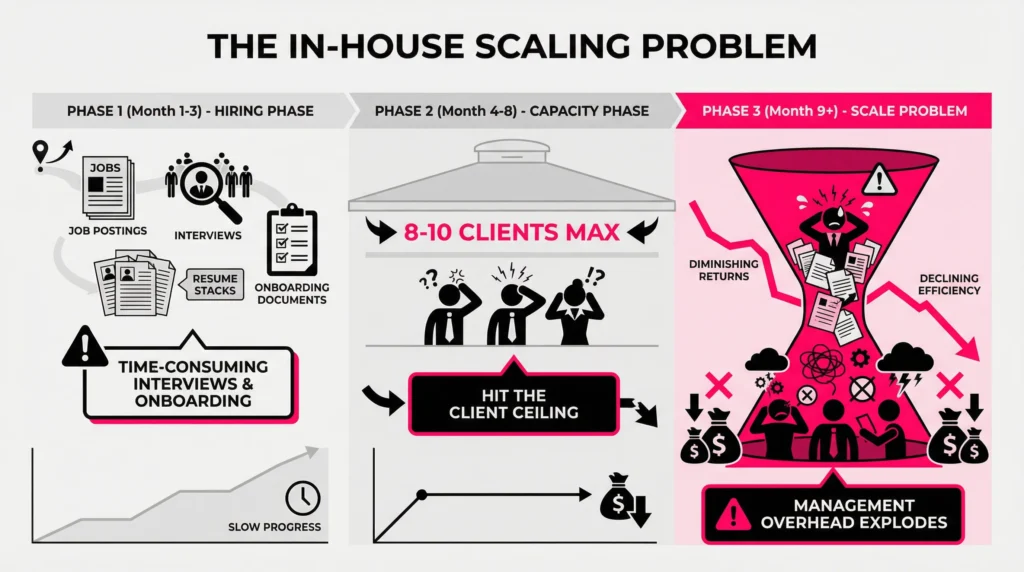
Here’s what actually happens when you try to build local SEO in-house:
Month 1-3: The Hiring Phase
You post a job for an SEO specialist. You sort through 100+ applications, most unqualified. You spend 20 hours interviewing. You finally hire someone who seems competent.
They need onboarding time. Learning your clients, your processes, your reporting standards, your communication style. Nothing productive happens for 4-6 weeks.
Month 4-8: The Capacity Phase
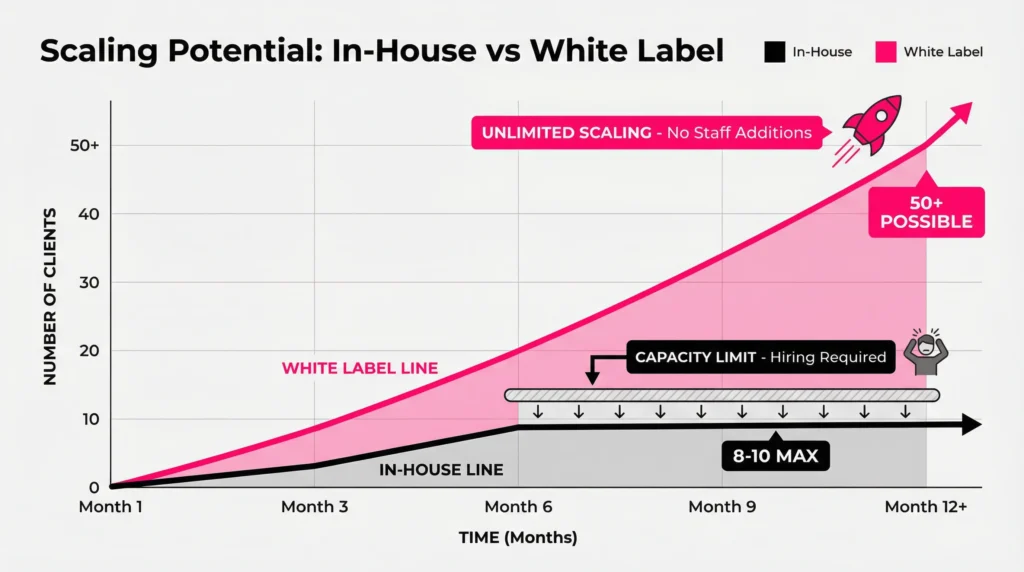
Your new hire finally hits productive output. They can handle maybe 8-10 local SEO clients before quality starts degrading. That’s the ceiling for one person doing comprehensive work.
You’re now managing someone instead of growing your agency. Daily check-ins, quality reviews, client escalations, performance issues. Your time gets consumed by management, not strategy.
Month 9+: The Scale Problem
You need to grow past 10 clients. That means hiring again. Now you’re running a people business, not a service business. More interviews, more training, more management overhead.
One person quits or underperforms, and your entire local SEO operation craters. Client deliverables get delayed. Quality drops. Churn increases. You’re fighting fires instead of building your agency.
Pro Tip: Calculate the true cost of an in-house SEO specialist. Salary plus benefits typically runs $60,000-$85,000 annually in the US. Add tools ($3,000-$5,000/year for proper software), training time, management overhead, and recruitment costs. You’re at $75,000-$100,000 before delivering to a single client.
The bottleneck isn’t expertise. It’s the operational complexity of managing people who do specialized work. Every new hire multiplies your management burden.
The consistency problem:
Client A gets your new hire’s best work. Client B gets their average work. Client C gets neglected because the first two are demanding. Quality varies by workload, not by standard.
You can’t systematize one person’s output. You can’t create redundancy. You can’t take vacation without everything stopping. The business depends on individuals, not infrastructure.
Scale Without Hiring: The Infrastructure Advantage
White label flips the model. Instead of building a team, you plug into existing infrastructure. Instead of managing people, you manage relationships and client outcomes.
The 50+ agency proof point:
Search Visibility Masters serves over 50 agencies across the US, UK, Australia, and Canada. Not 50 total clients ever. 50 active agency partners right now.
That scale proves systematic delivery. One agency might stay because they got lucky with a good account manager. Fifty agencies stay because the infrastructure works predictably.
This isn’t unique to Search Visibility Masters. Successful white label providers operate at this scale because agencies need reliability, not personality. Systems beat heroes.
Instant capacity vs 3-6 month ramp time:
You close a new client on Monday. You submit their details to your white label provider on Tuesday. Work starts by Thursday. The client sees their first report 30 days later.
No job posting. No interviewing. No training period. No wondering if they’ll work out. Capacity exists immediately because the provider already has teams, processes, and tools in place.
You can close 5 clients this month or 15 clients next month. Your workload stays the same. The provider scales their team allocation based on your volume. That’s what infrastructure does.
Margin protection through predictable costs:
In-house SEO costs fluctuate wildly. Hiring spikes, tool subscriptions, training, turnover replacement, benefits increases. Budgeting becomes guesswork.
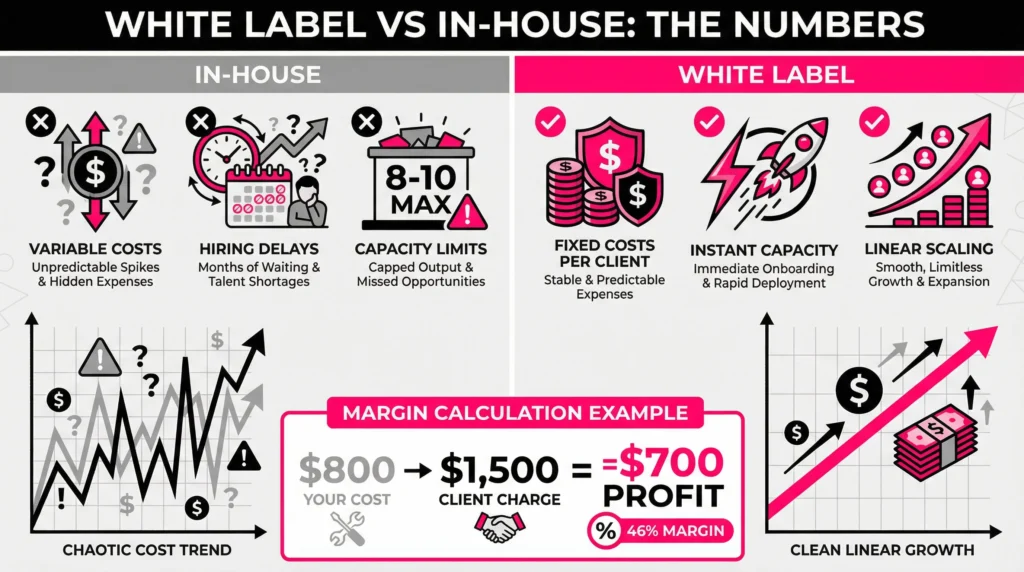
White label gives you fixed costs per client. You pay X per month for each client delivered. You charge $Y to your client. Your margin ( Y minus $X) stays consistent and predictable.
Most agencies target 40-60% margin on white label services. If your provider charges $800/month and you charge clients $1,500/month, you net $700 per client with zero delivery burden.
That margin scales linearly. Ten clients = $7,000/month profit. Twenty clients = $14,000/month. Your revenue grows without your costs spiking from hiring.
Did You Know? According to the U.S. Bureau of Labor Statistics, the median cost of employee turnover ranges from 50-200% of annual salary depending on role complexity. For an $70,000 SEO specialist, replacement costs can hit $35,000-$140,000 when factoring in lost productivity and training time.
Ability to take on overflow or spike demand:
Your web design agency just closed 8 new clients in one month. They all want ongoing SEO. You can’t hire fast enough to handle the spike.
With white label, you just onboard all 8. The provider absorbs the capacity increase. Three months later, if demand drops, you’re not stuck with overhead you can’t afford.
Seasonal businesses, referral spikes, or unexpected growth all become opportunities instead of operational nightmares. Infrastructure flexes. People don’t.
When White Label Makes Sense (And When It Doesn’t)
White label isn’t the right answer for every agency. Understanding when it works (and when it fails) prevents expensive mistakes.
Ideal scenarios for white label:
High volume, standardized services: You’re selling local SEO packages to restaurants, dentists, plumbers, or other local businesses. The work is repeatable. The deliverables are consistent. Volume makes the economics work.
Predictable demand: You close 3-5 new local SEO clients per month consistently. Enough volume to justify the overhead of managing a white label relationship, but not so much that in-house becomes cheaper.
Focus on client relationships: Your strength is sales, strategy, and client management. You’d rather own the front-end relationship than execute the back-end work. White label lets you stay in your zone of genius.
Rapid scaling goals: You want to double revenue in 12-18 months. Hiring can’t keep pace with that growth timeline. White label provides immediate capacity.
Poor fit scenarios:
Highly custom work: Your clients need bespoke SEO strategies with unusual requirements. Each engagement looks completely different. Standardized white label processes won’t flex enough.
Very small scale: You have 2-3 local SEO clients and don’t plan to grow. The overhead of managing a white label relationship costs more than just doing the work yourself.
Specific niche expertise required: You serve a vertical that needs specialized knowledge your general white label provider doesn’t have. Example: enterprise franchise local SEO with complex location hierarchies.
Control requirements: You need complete visibility into every task, every decision, and every action taken. You want to approve link targets, review every piece of content, and micromanage execution. White label requires trust, not control.
Pro Tip: The best time to evaluate white label is when you’re at 5-8 local SEO clients. Small enough that failure doesn’t destroy your agency, large enough that the economics make sense, and growth potential justifies the transition effort.
Self-assessment framework:
Ask yourself these five questions:
- Can I clearly define what success looks like for a local SEO client? If yes, white label can deliver to that standard. If no, you need to figure out the strategy first.
- Am I comfortable not controlling every tactical decision? If yes, white label works. If you need to approve every link, every piece of content, every citation, stay in-house.
- Do I have enough margin to make 40-60% profit acceptable? If yes, white label makes sense. If you need 80%+ margin, you’ll need to deliver yourself.
- Can I commit to at least 3-6 months to evaluate a provider properly? If yes, proceed. If you expect perfect results in 30 days, you’ll churn through providers and never find the right fit.
- Is my agency growth plan built on scaling local SEO, or is it just one small service? If scaling local SEO matters, white label enables that. If it’s tangential, the overhead might not justify the benefit.
Three or more “yes” answers typically indicate white label fits your model. Two or fewer suggests you should wait or pursue a different strategy.
What’s Actually Included in a White Label Local SEO Package
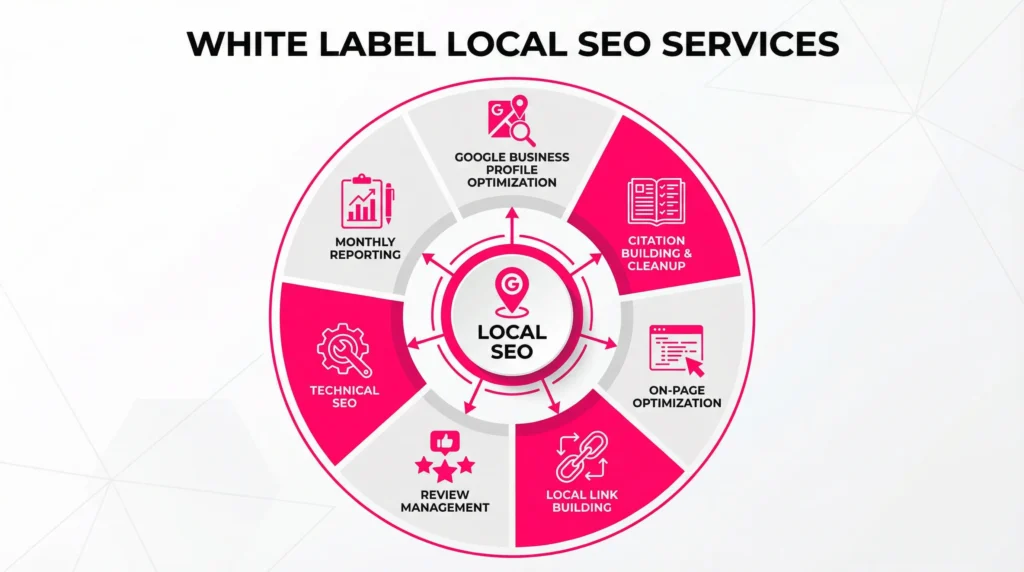
Core Local SEO Services You Should Expect
Package details vary between providers, but core local SEO services stay consistent. If a provider’s “standard package” is missing these elements, you’re not getting comprehensive local SEO.
Google Business Profile optimization (setup through ongoing management):
This isn’t a one-time setup. Proper GBP optimization includes claiming or creating the profile, verifying ownership, filling out every section completely, selecting accurate categories, uploading photos, and writing an optimized business description.
Ongoing management matters more than initial setup. Weekly or bi-weekly posts, responding to questions, monitoring for suspension risks, updating hours for holidays, adding new services or products as they launch.
Most local searches trigger the map pack. If your client’s GBP isn’t fully optimized and actively maintained, they’re invisible where it matters most.
Local citation building and cleanup (NAP consistency):
Citations are mentions of your client’s business name, address, and phone number across the web. Google uses citation consistency as a trust signal for local rankings.
Building citations means getting your client listed on directories like Yelp, Yellow Pages, Bing Places, Apple Maps, industry-specific directories, and local chamber of commerce sites. Most comprehensive local SEO requires 40-60 citations minimum.
Citation cleanup fixes existing listings with wrong information. Wrong phone number, old address, misspelled business name. These inconsistencies hurt rankings and confuse customers trying to contact your client.
Pro Tip: According to Moz’s Local Search Ranking Factors study, citation signals account for approximately 7% of local pack ranking factors and 10% of localized organic ranking factors. Not the biggest factor, but significant enough that ignoring citations costs rankings.
On-page optimization for local keywords:
Your client’s website needs to target local search terms. “Plumber in Austin” not just “plumber.” “Family dentist near downtown Denver” not just “family dentist.”
On-page optimization includes title tags, meta descriptions, header tags (H1, H2, H3), body content, image alt text, and internal linking structure. All optimized for local search intent.
This also means creating location pages if your client serves multiple areas. Each page targets that specific location with unique, valuable content. Not just template pages with the city name swapped.
Local link building strategies:
Backlinks from local websites signal relevance and authority to Google. A link from the local chamber of commerce, a neighborhood blog, or a local news site carries more weight for local rankings than a random national directory.
Legitimate local link building focuses on relationships. Sponsoring local events, getting featured in local media, participating in community initiatives, partnering with complementary local businesses.
What it’s not: buying links, using PBNs (private blog networks), spamming blog comments, or any black-hat tactics that risk penalties.
Review management and monitoring:
Online reviews directly impact local rankings and customer trust. More reviews (especially positive ones) correlate strongly with higher local pack placement.
Review management includes monitoring new reviews across Google, Yelp, Facebook, and industry-specific platforms. Responding to reviews (both positive and negative) professionally and promptly. Encouraging satisfied customers to leave reviews through systematic follow-up.
Some providers handle response drafting. Others alert you to new reviews and let you handle responses. Clarify this upfront.
Technical SEO foundation work:
Local SEO still requires solid technical fundamentals. Site speed, mobile responsiveness, proper schema markup (especially LocalBusiness schema), XML sitemaps, robots.txt configuration, HTTPS security.
Technical SEO isn’t flashy, but poor technical health tanks all other efforts. A slow, broken site won’t rank regardless of how many citations you build.
Monthly reporting (branded):
You need visibility into what’s being done and what results are happening. Monthly reports should include ranking changes for target keywords, Google Business Profile insights (views, clicks, calls, direction requests), website traffic from local search, new citations built, links acquired, and reviews generated.
These reports arrive fully branded with your agency logo and colors. The client never sees the provider’s information.
What Gets Missed in Standard Packages (And Why It Matters)
Most white label providers offer “comprehensive local SEO,” but dig deeper and you’ll find gaps. Understanding what’s typically missing helps you evaluate providers honestly.
GBP posting schedules and content:
Many providers optimize your client’s Google Business Profile once, then ignore it. But Google rewards active profiles. Regular posts (weekly or bi-weekly) about services, promotions, updates, or helpful content keep the profile fresh.
Posts appear in search results and on your client’s profile. They signal to Google that the business is active and engaged. Neglecting posts means losing easy ranking improvements.
Ask providers: “How often do you post to GBP, and who creates the content?” If they say “we can do that for an extra fee,” that’s not comprehensive service.
Competitive analysis and positioning:
Ranking your client in a vacuum accomplishes nothing if their top 3 competitors all outrank them. Proper local SEO includes competitive analysis.
Who ranks in positions 1-3 for your target keywords? Why are they ranking? What are they doing that your client isn’t? How big is the gap? How long will it realistically take to close?
This analysis should happen during onboarding and periodically thereafter. Market dynamics change. New competitors emerge. Your strategy needs to adapt.
Local keyword research depth:
“Plumber in Austin” is obvious. But what about “emergency plumber Austin,” “water heater repair Austin,” “slab leak detection Austin,” or “Austin plumber same day service”?
Thorough keyword research uncovers the full range of local search terms people actually use. Many providers target the obvious head terms and ignore the long-tail variations that drive most actual leads.
The difference between surface-level and comprehensive keyword research can be 50+ additional ranking opportunities.
Did You Know? Research from Ahrefs shows that 92.42% of keywords get 10 monthly searches or fewer. For local businesses, these “long-tail” local variations often have higher commercial intent than broad head terms because searchers are being more specific about what they need.
Citation audit vs citation build distinction:
Building new citations is easy. Auditing and cleaning up existing bad citations is hard. Most providers default to the easy path.
If your client has been in business for 10+ years, they likely have dozens of outdated or incorrect citations floating around the web. Old addresses, disconnected phone numbers, previous business names.
A proper provider audits first, cleans up existing citations, then builds new ones. Skipping the audit means building on a broken foundation.
Review response protocols:
Getting reviews helps. Responding to reviews matters more than most providers admit. But who’s actually writing the responses? You? The provider? The client?
Establish clear protocols. Some providers offer review response drafting as a standard service. Others expect you or your client to handle it. Misaligned expectations here damage your client relationship fast.
Negative review responses especially need careful handling. A poorly written response makes things worse.
Performance attribution vs vanity metrics:
Many reports focus on vanity metrics. “We built 15 citations this month!” Okay, but did rankings improve? Did calls increase? Did revenue grow?
The best providers track performance metrics that actually matter: keyword rankings in the local pack, organic traffic from local search terms, form submissions, phone calls, direction requests, website conversions.
Attribution is hard in local SEO, but quality providers show the connection between their work and your client’s business outcomes.
Package Tiers and Pricing Models Explained
White label pricing isn’t standardized. Understanding common models helps you negotiate better deals and set appropriate client pricing.
Cost-plus model (typical 40-60% margin):
This is the most common model. The provider charges you a wholesale rate. You mark it up to your client at whatever margin makes sense for your agency positioning.
Example: Provider charges you $800/month. You charge your client $1,500/month. Your margin is $700 (47%).
Your margin varies based on your market positioning, client expectations, and competitive dynamics. Agencies serving enterprise clients can command higher prices. Agencies competing on price need to accept lower margins.
Pro Tip: Don’t price based solely on provider cost. Price based on value delivered to your client. A local business generating $50,000/month in revenue shouldn’t flinch at $1,500-$2,500/month for the SEO driving their leads. Price to value, not to cost.
Tiered packaging (Standard/Premium structures):
Most providers offer 2-4 package tiers. Each tier includes more services, faster turnaround, or additional features.
Standard tier might include: Basic GBP optimization, 20 citations, 2 local links per month, monthly reporting.
Premium tier adds: Weekly GBP posts, 40 citations, 5 local links per month, review management, quarterly strategy calls.
Enterprise tier includes: Everything in Premium plus custom local content, competitive analysis, advanced schema implementation, priority support.
Tiered packaging lets you serve different client budgets without custom quoting every engagement. Standardization improves margin predictability.
Monthly retainer vs project-based:
Most local SEO is sold as monthly retainers. The work is ongoing. Rankings require continuous effort. One-time projects work for audits or initial setup, but sustainable results need monthly execution.
Providers typically prefer monthly retainers because they create predictable revenue. You should prefer them too because they create predictable cash flow and higher lifetime value per client.
Project-based pricing works for specific deliverables: “Complete citation audit and cleanup” or “Initial GBP optimization package.” But you’ll want to transition those clients to ongoing retainers for best results.
What drives price differences between providers:
Geography matters. US-based providers cost more than offshore providers. You’re paying for communication quality, local market knowledge, and time zone alignment.
Service scope varies wildly. One provider’s “comprehensive local SEO” includes 20 citations. Another includes 60. Compare deliverables, not just price tags.
Team experience and tools make a difference. Providers using enterprise-grade tools (Ahrefs, SEMrush, BrightLocal, Local Falcon) and employing seasoned SEO specialists cost more than those using free tools and junior freelancers.
Scale creates efficiency. Larger providers serving 50+ agencies can negotiate better tool pricing and systematize workflows more effectively than small shops. That efficiency sometimes translates to better pricing or better quality at similar pricing.
Typical pricing ranges for reference:
Basic local SEO packages from white label providers typically run $400-$800/month wholesale. This covers single-location optimization with standard deliverables.
Comprehensive packages run $800-$1,500/month wholesale. This includes more aggressive link building, content creation, review management, and advanced optimization.
Enterprise or multi-location packages can exceed $2,000/month wholesale depending on complexity and number of locations.
These are wholesale prices you pay the provider. Your client-facing prices should be 1.5x to 2.5x higher depending on your positioning and market.
How to Evaluate White Label Local SEO Providers (The Criteria That Actually Matter)
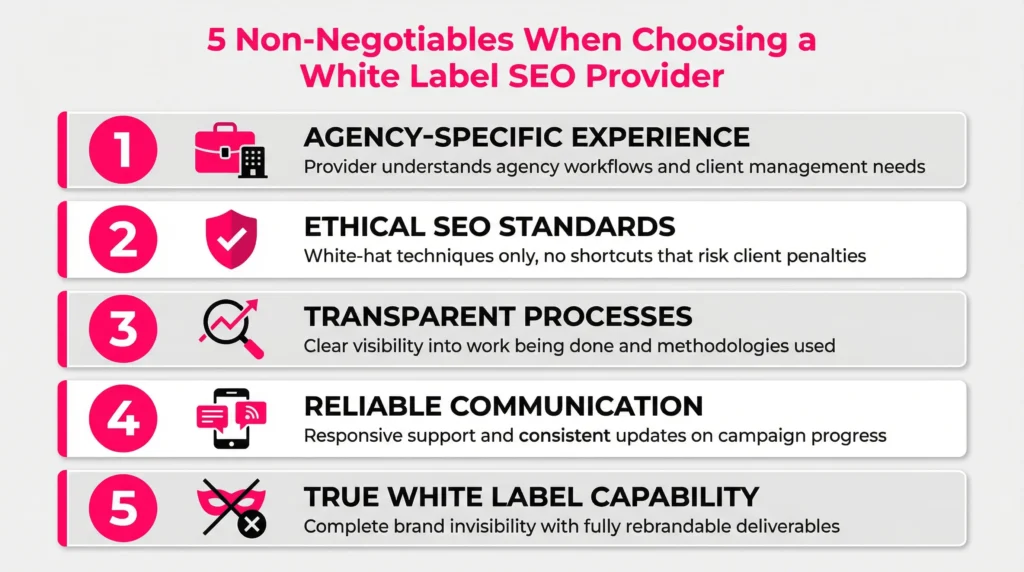
Beyond Case Studies: Proof Points That Mean Something
Every white label provider has case studies showing impressive results. “We increased rankings 300%!” Great. But case studies can be cherry-picked, context-stripped, or outright fabricated.
Smart agencies look past the marketing materials to find proof points that actually predict future performance.
Track record with agencies specifically (not end clients):
A provider serving 100 direct clients proves they can do SEO. A provider serving 50 agency partners proves they can operate as white label infrastructure.
The skills are different. Direct client work requires sales, customer service, and flexibility. White label work requires systematization, invisibility, and consistent quality across multiple agency brands.
Ask: “How many active agency partners do you currently serve?” If they hesitate or give vague answers, they probably don’t have significant agency experience.
Search Visibility Masters serves 50+ agencies specifically because the business model demands different infrastructure than serving direct clients.
Years in operation and agency client count:
Longevity signals stability. A provider operating since 2017 has survived algorithm updates, economic downturns, and competitive pressure. They’ve seen what works long-term versus what works temporarily.
New providers aren’t automatically bad, but they haven’t proven operational consistency yet. You’re taking more risk with your client relationships.
Combine years in business with current agency count. A provider operating for 8 years but only serving 5 agencies suggests retention problems. A provider operating for 3 years serving 30 agencies suggests rapid growth but possible quality inconsistency.
Retention metrics (how long agencies stay):
This is the proof point most providers won’t share because it’s the most revealing. How long do agencies typically stay with you? What’s your 12-month retention rate?
Quality providers have agencies that stay for years. Poor providers churn through agencies every 6-12 months as quality problems emerge and agencies switch to competitors.
If a provider claims “most agencies stay with us long-term” but can’t provide specific retention data, assume the numbers aren’t good.
Pro Tip: Ask for 3-5 agency references you can contact directly. Specifically request agencies who have been clients for 2+ years. Then ask those agencies: “What almost made you leave?” The answer reveals more than “What do you like?”
Process documentation transparency:
Legitimate providers document their processes in detail. How do they build citations? What’s their link building methodology? How do they handle GBP optimization? What tools do they use?
If a provider says “we use proprietary methods we can’t disclose,” that’s a red flag. Either they don’t have consistent processes, or they’re hiding tactics you wouldn’t approve of.
Documented processes also enable quality control. You can audit whether work is being done to the promised standard. Black box operations make this impossible.
The Five Non-Negotiables for Provider Selection
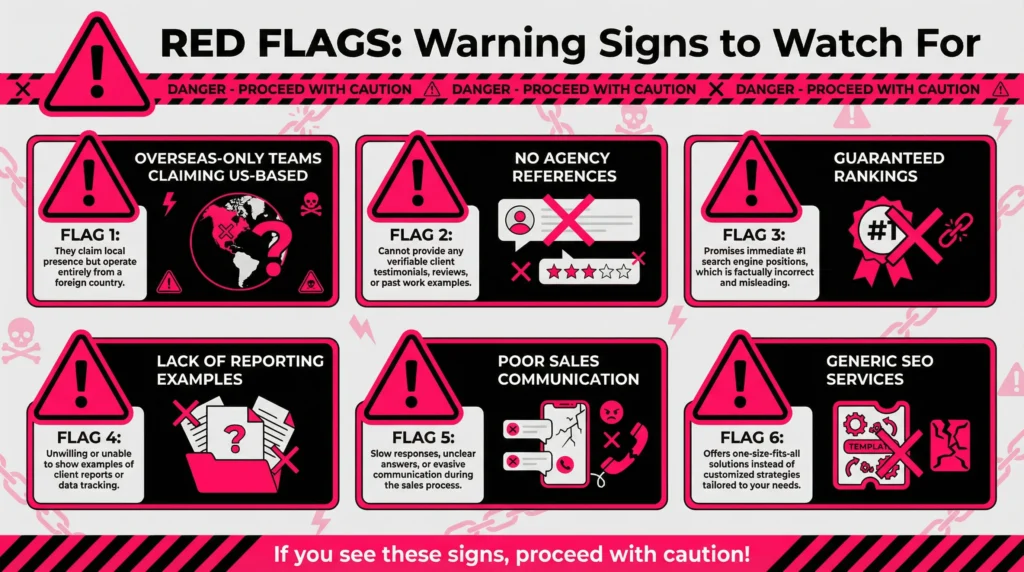
These five criteria separate infrastructure from vendors. Compromise on any of them and you’re setting yourself up for problems that cost you clients.
1. Agency-specific experience: Built for resellers, not repurposed end-client services
Many “white label” providers are just regular SEO agencies that also work with other agencies. They haven’t built systems specifically for white label operations.
The tell: They talk about “our clients” instead of “our agency partners.” They reference direct client work prominently. Their website is client-facing, not agency-facing.
Real white label infrastructure is designed exclusively for agencies. Their entire business model depends on keeping agencies successful. They don’t compete for your clients because serving agencies is more profitable.
2. Ethical SEO standards: No black-hat, no shortcuts, algorithm-proof methods
You’re putting your reputation in their hands. If they use black-hat tactics (link schemes, keyword stuffing, cloaking, fake reviews), your clients get penalized. Your brand takes the hit.
Ask directly: “What SEO tactics do you specifically avoid?” Good providers have a clear answer. They know what doesn’t work long-term and explicitly avoid it.
Ethical SEO is slower but sustainable. Rankings built on legitimate authority, quality content, and real local signals survive algorithm updates. Shortcuts get wiped out every few months.
Did You Know? Google releases multiple algorithm updates per year. According to SEO data from Moz, the average website that experienced ranking drops from updates took 3-6 months to recover, and some never fully recovered. Ethical, sustainable SEO protects against this volatility.
3. Transparent processes: Documented workflows you can audit
You should be able to understand exactly what work happens each month. “We do local SEO” isn’t enough. You need specifics.
Request their standard operating procedures for key deliverables. How do they verify citation accuracy? What criteria do they use for selecting link targets? How do they optimize GBP categories?
Documentation proves process exists. If they can’t show you documented workflows, they’re making it up as they go. That inconsistency destroys quality across multiple clients.
4. Reliable communication: Response times, update cadence, escalation protocols
Communication breakdowns are the #1 reason agencies switch white label providers. Not quality. Not price. Communication.
Establish expectations upfront. What’s your guaranteed response time for normal questions? For urgent issues? Who’s my point of contact? What happens if they’re unavailable?
The best providers assign dedicated account managers. You’re not emailing a general support queue. You have a human who knows your agency, your clients, and your preferences.
5. True white label capability: Complete invisibility, brand protection enforced
This sounds obvious but many providers fail here. They’re white label in name only.
Test this during evaluation: “How do you ensure your team never contacts my clients directly, even accidentally?” The answer should involve technical systems, not just policies.
Ask to see sample reports. Are they truly brandable? Can you customize templates? Is any provider information visible in metadata or footer text?
Request their non-disclosure and non-compete agreements. What legally prevents them from poaching your clients or competing with your agency?
Expert Pick: Search Visibility Masters built their infrastructure specifically for agencies, not end clients. Since 2017, they’ve operated under a strict no-client-contact policy enforced through technical systems and contractual agreements. That’s not marketing language. That’s operational reality proven over 8 years serving 50+ agencies.
Red Flags That Signal a Bad Partner
Most agency-provider relationships fail within the first 6 months. These red flags predict failure before you sign a contract.
Overseas-only teams claiming “US-based” (language/time zone issues):
A provider headquartered in the US but with 100% overseas fulfillment isn’t really US-based. Geography of incorporation doesn’t matter. Geography of team execution does.
Time zones create response delays. Your client’s GBP gets suspended at 9am EST. Your provider’s team starts work at 9pm EST. The problem sits unresolved for 12 hours while your client panics.
Language barriers complicate communication. Not because overseas teams lack English skills, but because nuance matters in local SEO. Understanding “near me” search intent requires understanding local search behavior.
No agency references or vague client counts:
“We serve dozens of agencies” without specifics means they probably serve fewer than 5. “We’ve worked with many agencies over the years” means most left.
Legitimate providers eagerly share references. “Here are 5 agencies you can call right now who’ve been with us for 2+ years.”
If they cite confidentiality as a reason for not sharing references, offer to sign an NDA. If they still refuse, walk away. They’re hiding something.
Guaranteed rankings or unrealistic timelines:
“We guarantee page 1 rankings in 30 days” is either a lie or a sign they use tactics that eventually get penalized.
Local SEO takes 3-6 months to show meaningful results. Anyone promising faster is using shortcuts or setting you up for disappointment.
Ranking guarantees specifically violate Google’s guidelines and should make you immediately skeptical of the provider’s methods.
Lack of reporting examples or customization:
“We provide comprehensive monthly reports” without showing you an example means those reports are probably inadequate.
Request a sample report during evaluation. Redact the client information but show the format, metrics tracked, and level of detail.
If reports aren’t customizable (your logo, your colors, your format preferences), you’re stuck with whatever template they use. That inconsistency makes you look unprofessional.
Poor communication during sales process:
Sales interactions predict operational interactions. If they take 3 days to respond during sales (when they should be most responsive), expect worse during fulfillment.
If they’re pushy, vague, or dismissive of your questions during evaluation, those behaviors intensify after you sign.
If onboarding requirements are unclear, documentation is missing, or they can’t explain their process coherently, operations will be chaotic.
Pro Tip: The sales process is a provider’s best behavior. They’re trying to impress you. If communication is already frustrating, it only gets worse after the contract is signed.
Generic “SEO services” without local specialization:
Providers claiming to do “all types of SEO” rarely excel at any specific type. Local SEO requires specialized knowledge that general SEO practitioners often lack.
Ask: “What percentage of your work is local SEO specifically?” If it’s less than 70%, they don’t have the focused expertise that produces consistent local results.
Local SEO isn’t just “SEO with a geographic modifier.” It requires understanding GBP optimization, local pack algorithms, citation ecosystems, review dynamics, and local link building. Generalists miss the nuance.
Questions to Ask Before Signing
These 12 questions reveal more than any marketing materials. Take notes on the answers. Vague responses or deflection are warning signs.
About their agency experience:
- “How many agency partners do you currently serve?” (Look for specific numbers, not ranges.)
- “What’s your average agency retention time?” (Good answer: 2+ years. Red flag: “We don’t track that.”)
- “Can you share 3-5 agency references I can contact?” (Should provide immediately without hesitation.)
About their process:
- “Walk me through your exact citation building process, step by step.” (Tests documentation and transparency.)
- “What link building tactics do you specifically avoid and why?” (Tests ethical standards.)
- “How do you handle Google Business Profile suspensions or ranking drops?” (Tests problem-solving capability.)
About communication and operations:
- “Who will be my point of contact, and what’s their guaranteed response time?” (Tests communication structure.)
- “How do you prevent your team from accidentally contacting my clients?” (Tests white label systems.)
- “Can I review a sample report with real data but redacted client info?” (Tests reporting quality.)
About pricing and terms:
- “What’s included in your base package vs what costs extra?” (Tests pricing transparency.)
- “What’s your cancellation policy and notice period?” (Tests flexibility and confidence.)
- “Can I start with 1-2 test clients before committing larger volume?” (Tests willingness to prove capability.)
What good answers sound like:
Specificity wins. “We serve 53 active agency partners as of this month” beats “We work with lots of agencies.”
Documentation trumps explanations. “Here’s our 47-step citation building SOP you can review” beats “We have a thorough process.”
References matter most. “Here are 5 agency owners you can call right now” beats “Our clients love us.”
Deal-breakers vs nice-to-haves:
Deal-breakers (walk away if missing):
- Specific agency client count and references
- Documented, ethical SEO processes
- Clear communication protocols
- True white label systems (no client contact)
- Transparent, customizable reporting
Nice-to-haves (valuable but not essential):
- Industry-specific experience
- Advanced reporting dashboards
- Priority support tiers
- Custom package creation
- Training resources for your team
Compromise on nice-to-haves if budget is tight. Never compromise on deal-breakers. They predict whether the relationship succeeds or fails.
The Operational Reality: What Working with a White Label Provider Looks Like
Month 1: Onboarding and Setup
The first month reveals whether you chose a real partner or just another vendor. Quality providers make onboarding systematic. Poor providers make it chaotic.
Client handoff process and requirements:
You’ve closed your first white label client. Now you need to transfer their information to your provider. Proper providers have structured intake forms or portal systems that capture everything needed in one submission.
What you’ll typically need to provide:
- Business name, address, phone number (the NAP)
- Website URL and current hosting/CMS access
- Google Business Profile ownership access
- Existing Google Analytics and Search Console access
- Target service areas and keywords
- Competitor websites for analysis
- Any existing SEO history or past provider work
This handoff should take 15-30 minutes maximum. If you’re exchanging 20 emails just to get started, the provider lacks proper systems.
Timeline expectations (realistic vs promises):
Quality providers set realistic timelines upfront. Initial audit and strategy development takes 5-7 business days. Meaningful ranking movement takes 60-90 days minimum. Significant traffic increases take 90-120 days.
Anyone promising “first page rankings in 30 days” is either targeting zero-competition keywords or using tactics that’ll get your client penalized later.
Month one is mostly setup work. Claiming and optimizing the Google Business Profile, conducting competitive analysis, identifying citation gaps, planning link building targets, fixing technical issues.
Your client won’t see dramatic results yet. Set this expectation with them before starting. “Month one is building the foundation. You’ll see initial movement in months 2-3, with momentum building from there.”
Pro Tip: The best predictor of long-term success is a thorough month-one audit. Providers who rush past this phase to show “quick wins” inevitably create bigger problems later. Proper foundation work feels slow but pays off in consistent results.
What you’ll need to provide:
Beyond the initial data handoff, providers may need ongoing input during month one.
Clarification on service offerings: “Does your client do emergency calls?” Approval on business category selection: “Primary category should be ‘Plumber’ or ‘Emergency Plumbing Service’?” Confirmation of service area boundaries: “Do they serve all of Austin or just specific zip codes?”
These questions are normal. They show the provider is customizing the strategy rather than applying a generic template. Answer promptly to avoid delays.
Some providers require kickoff calls to align on strategy and expectations. Others work asynchronously through documentation. Both approaches work if executed well.
First reporting cycle:
Your first monthly report arrives 30-35 days after client handoff. This report documents baseline metrics and all work completed in month one.
Review it carefully before forwarding to your client. Check for accuracy (business name spelled correctly, correct service areas listed, proper keywords targeted). Verify completeness (were all promised deliverables included?). Ensure branding is correct (your logo, your colors, no provider information visible).
This first report sets the tone for your client relationship. If it’s sloppy or incomplete, fix it with the provider before your client sees it. Your brand is on the line.
Months 2-6: Execution and Momentum Building
The next five months reveal the provider’s true capabilities. Initial setup is easy. Consistent execution across months separates quality infrastructure from unreliable vendors.
What work happens when:
Proper providers follow documented monthly workflows. You shouldn’t need to micromanage task completion.
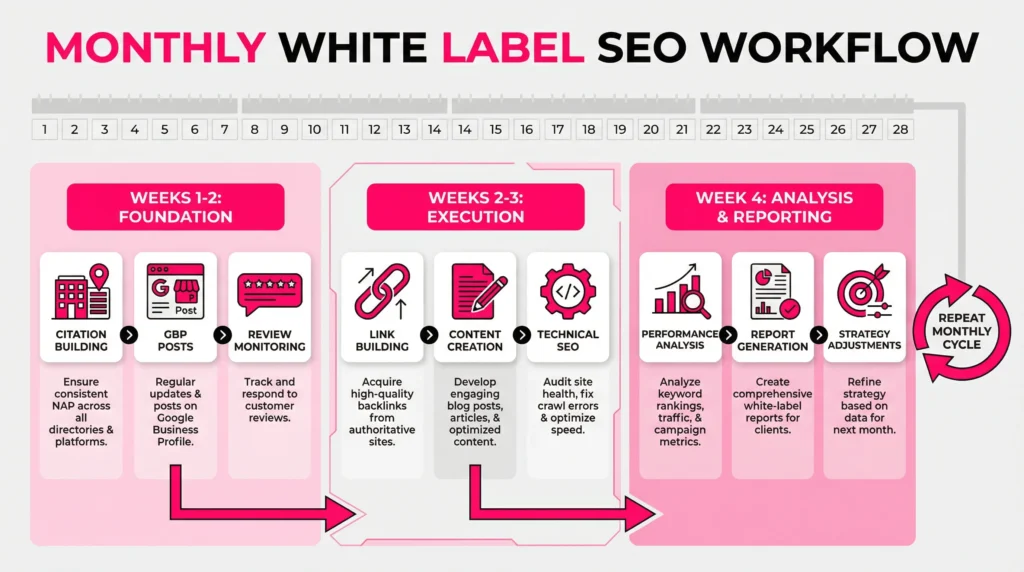
Typical monthly execution includes:
Weeks 1-2: New citations built (8-12 per month in growth phase), Google Business Profile posts created and published (2-4 per month), review monitoring and response, local keyword ranking tracking.
Weeks 2-3: Local link building outreach and placement (2-5 quality links per month), on-page optimization updates, content creation for location pages or blog posts, technical SEO maintenance and monitoring.
Week 4: Performance analysis and reporting compilation, next month strategy adjustments based on results, report delivery to you for review and approval.
This workflow should feel invisible to you. Work happens predictably. Updates arrive proactively. You’re not chasing status or wondering what’s being done.
How to track progress without micromanaging:
You’re not managing a team. You’re monitoring infrastructure reliability. The goal is knowing things are on track without daily oversight.
Most quality providers offer portal access where you can check project status anytime. Login and see: what work was completed this week, current keyword rankings, citations built and verified, links acquired, upcoming tasks scheduled.
You don’t need to check daily. Weekly glances keep you informed without consuming your time.
If you find yourself checking constantly or feeling anxious about whether work is happening, you either chose the wrong provider or you’re micromanaging out of habit rather than necessity.
Did You Know? According to BrightLocal’s Local Consumer Review Survey, 87% of consumers read online reviews for local businesses in 2024. The businesses with consistent review generation and response (which quality providers systematically manage) significantly outperform competitors in local pack rankings.
Managing client expectations during ramp period:
Months 2-4 are the ramp period. Work is happening consistently, but results take time to compound. Rankings gradually improve. Traffic slowly increases. Leads start flowing.
Impatient clients kill their own success by expecting immediate results. Your job is setting proper expectations upfront and reinforcing them during the ramp.
Useful framing: “SEO is compound interest for your website. Month one builds the foundation. Months 2-3 show initial movement. Months 4-6 is where momentum really builds. Most clients see their best results in months 6-12 as everything compounds.”
Share the monthly reports as proof of work being done. Point out ranking improvements even if they’re not page one yet. “You moved from position 15 to position 8 for ’emergency plumber Austin.’ That’s real progress toward the top 3.”
Celebrate small wins. They become big wins with time and consistency.
When to escalate issues:
Most month-to-month operations should run smoothly. But issues occasionally arise that need escalation.
Escalate immediately:
- Google Business Profile suspension or verification problems
- Sudden ranking drops across multiple keywords (more than 5 positions)
- Negative SEO attacks (spam backlinks, fake negative reviews)
- Technical site issues breaking local SEO elements
- Missed reporting deadlines (reports not delivered within 48 hours of due date)
Monitor but don’t escalate immediately:
- Minor ranking fluctuations (2-3 positions up or down)
- Slow progress on specific keywords
- Client complaints about pace (manage expectations, don’t blame provider)
- Single negative review (part of normal business operations)
Know the difference between normal SEO volatility and real problems. Google’s algorithm fluctuates constantly. Rankings bounce around weekly. Traffic varies seasonally.
Escalating every minor change signals you don’t understand SEO fundamentals. Save escalations for genuine issues requiring provider intervention.
Pro Tip: Keep a simple spreadsheet tracking key metrics monthly: average local pack position, top 10 keywords count, monthly organic sessions, phone calls from GBP. This baseline helps you spot real problems versus normal fluctuation.
Month 6+: Maintenance and Scale
Month six marks a transition point. The foundation is built. Initial momentum is visible. Now the relationship either stabilizes into reliable infrastructure or problems reveal themselves clearly.
Steady-state operations:
By month six, the workflow should feel predictable. Monthly reports arrive on schedule. Rankings continue improving or hold strong positions. Your client sees consistent lead flow from local search.
The provider shifts from aggressive growth tactics to maintenance and optimization. Less focus on building new citations (they’re mostly complete). More focus on earning quality links, publishing fresh content, and defending rankings against competitors.
This steady state is what you’re paying for. Boring reliability. No surprises. Consistent results. Infrastructure that doesn’t require your constant attention.
If month six still feels chaotic (missed deadlines, inconsistent quality, communication problems), you probably need to switch providers. Six months is enough time to evaluate whether the relationship works.
Adding new clients to your program:
You’ve proven the model works with your first few clients. Now you want to scale. Adding new clients should be effortless.
Same intake process you used for client one. Submit details, provider onboards, work begins. Your operational burden doesn’t increase. The provider scales their team allocation to handle your volume.
This is where white label’s value compounds. Client five takes the same effort to manage as client one. But your revenue is now 5x higher.
Most agencies hit capacity limits around 8-10 clients when managing in-house. With white label, agencies commonly manage 20-50 local SEO clients without adding staff.
Optimizing margin and pricing:
As you add more clients, you gain negotiating leverage with your provider. Volume discounts often kick in at 10+ clients or $10,000+ monthly spend.
Example: Standard pricing might be $800 per client monthly. At 15 clients, you negotiate down to $700. Your revenue stays the same but profit per client increases $100.
You can also optimize your client-facing pricing. As you build case studies and proven results, you can raise prices for new clients. Your cost stays fixed while your revenue per client increases.
This margin expansion is where white label becomes highly profitable. Year one you’re earning 40% margin learning the model. Year two you’re earning 50-60% margin through efficiency and pricing optimization.
When to consider bringing work in-house:
White label isn’t always the permanent solution. Some agencies eventually transition certain work in-house. Others stay white label forever. Both paths work.
Consider bringing work in-house when:
You have 30+ active local SEO clients and can justify hiring a full-time specialist whose salary costs less than your white label expenses at that volume.
You’ve developed specific expertise or methodology that differentiates you competitively and requires proprietary execution you can’t outsource.
You want complete control over every tactical decision and timeline. Some agency owners can’t psychologically accept infrastructure they don’t directly control.
Stay white label when:
The economics still work at your current volume. Provider costs are 40-50% of revenue. Your margins are healthy and predictable.
Your agency strengths lie in sales, strategy, and client relationships rather than SEO execution. Why build in-house if your zone of genius is elsewhere?
You’re still scaling rapidly and hiring can’t keep pace with growth. White label gives you unlimited capacity.
Expert Pick: Search Visibility Masters has agency partners who’ve been white label for 6+ years because the economics and operations work better than in-house at their scale. Others graduated to partial in-house after proving the model. Neither choice is “right.” It depends on your specific agency goals and strengths.
Most agencies overthink the in-house transition. The default should be staying white label unless you have a compelling reason to change. If it’s working, don’t fix it.
Making White Label Work for Different Agency Types
For Digital Marketing Agencies (Full-Service)
Full-service digital agencies typically offer paid ads, social media, content marketing, and web design. Adding local SEO completes the service stack, but most avoid it because of fulfillment complexity.
White label solves this without requiring you to become an SEO agency.
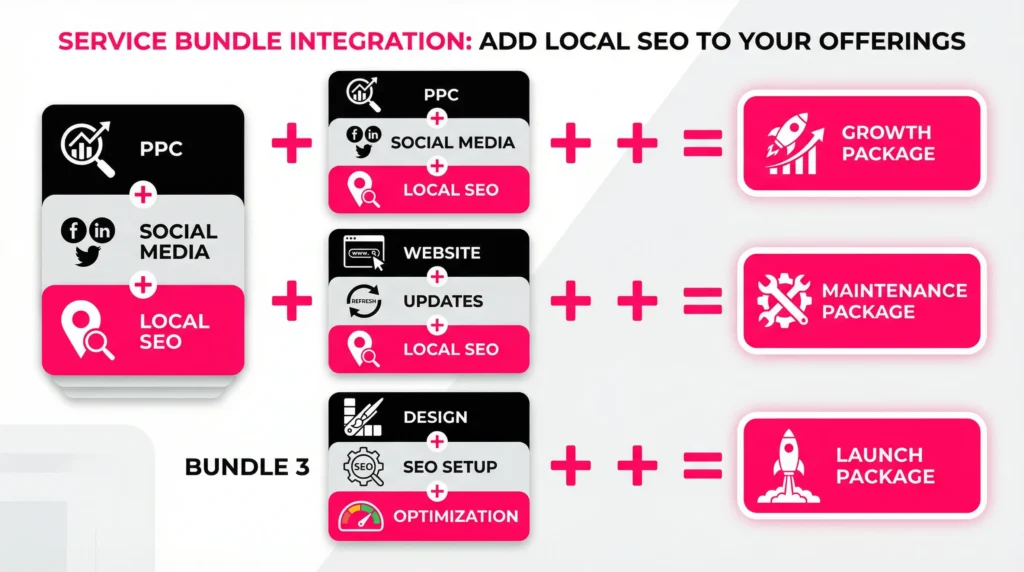
Adding local SEO to existing service stack:
Your clients already trust you for PPC and social media. Local SEO becomes a natural expansion of what you already do for them.
Position it as complementary, not competitive. “Your paid ads drive immediate leads. Local SEO builds long-term organic visibility. Together they reduce your customer acquisition cost over time.”
Most full-service agencies bundle local SEO with their existing services rather than selling it standalone. Website redesign projects naturally lead to “ongoing optimization” conversations. PPC clients ask about organic alternatives. Social media clients want better local discovery.
White label lets you say yes to all these opportunities without building an SEO department.
Cross-selling to current clients:
Your existing client base is your lowest-cost acquisition channel. They already trust you, pay you reliably, and understand your value.
Audit your current client roster. Which ones are local businesses? Restaurants, law firms, medical practices, home services, retail stores. They all need local SEO.
Simple pitch: “We’re expanding our local SEO capabilities to help clients like you show up in ‘near me’ searches and Google Maps. Based on what I see in your market, this could drive 10-15 additional leads per month. Want me to run a quick audit?”
Pro Tip: According to HubSpot’s sales data, selling to an existing customer has a 60-70% success rate compared to 5-20% for new prospects. Your current clients are your fastest path to local SEO revenue.
The audit reveals opportunities. “You’re not showing up in the map pack for any of your target keywords. Your top three competitors all are. Here’s what it would take to close that gap.”
Most clients say yes when the opportunity is clearly demonstrated and comes from a trusted partner.
Bundling strategies:
Bundle local SEO into your existing packages rather than selling it separately. This increases average client value without adding sales complexity.
Example bundling structures:
Growth Package: Paid ads + social media + local SEO. Position it as a complete local marketing system. Price it at a premium because clients get three services working together.
Maintenance Package: Website hosting + updates + local SEO. For clients who already have websites but need ongoing support. Local SEO justifies monthly recurring revenue.
Launch Package: Website design + initial SEO setup + 6 months of ongoing optimization. Perfect for new business launches or rebrands.
Bundling increases perceived value and reduces price sensitivity. Clients compare your $3,500/month Growth Package against competitors’ offerings, not against the individual component costs.
Team coordination with provider:
Your internal team handles client strategy, reporting, and communication. The white label provider handles SEO execution. Clear boundaries prevent overlap and confusion.
Weekly or bi-weekly internal syncs keep everyone aligned. Your account managers know what SEO work is happening. Your provider knows about upcoming client campaigns that need SEO support.
Example: Your client is launching a new service line next month. You tell your provider in advance. They create location pages and optimize GBP categories before launch. The client sees seamless coordination.
Poor coordination creates problems. Your client launches a new service. Your provider doesn’t know. The GBP doesn’t reflect the new offering for weeks. The client notices the disconnect.
For Web Design Agencies
Web design agencies have the perfect white label opportunity. You already build websites for local businesses. Adding ongoing SEO transforms one-time projects into recurring revenue.
Post-launch SEO upsell model:
Most web design projects end when the site launches. You deliver the finished website, collect final payment, and the relationship goes dormant until they need a redesign in 3-5 years.
That’s leaving money on the table.
The best time to sell ongoing SEO is right after launch. The client is excited about their new site. They’re thinking about growth and visibility. They’re already in spending mode.
Pitch: “Your new website looks great, but it’s invisible in search results right now. Local SEO gets you showing up when people search for [their services] in [their city]. Most of our clients add this right after launch to maximize their investment in the new site.”
Frame it as protecting their website investment, not as an upsell. They spent $8,000-$15,000 on a new site. Spending $1,200-$1,800/month to make sure it actually generates leads makes obvious sense.
Ongoing retainer positioning:
One-time projects create revenue spikes and valleys. Retainers create predictable monthly income.
Position local SEO as an essential ongoing service, not an optional add-on. “Your website needs continuous optimization to maintain and improve rankings. Search algorithms change constantly. Competitors are actively trying to outrank you. This isn’t a one-time fix.”
Most web design agencies offering SEO retainers structure them as 6 or 12-month minimum commitments. Month-to-month makes sense for established clients, but new clients need time for results to compound.
Did You Know? Research from Statista shows that 68% of online experiences begin with a search engine, and 46% of Google searches are seeking local information. A beautiful website that doesn’t rank in local search results drastically underperforms its potential.
How to sell ongoing services to one-time clients:
Your past web design clients are dormant revenue waiting to be activated. Most haven’t thought about SEO because you never offered it.
Email your past client list: “We’ve expanded our services to include local SEO optimization. I noticed [specific observation about their current search visibility]. Would it make sense to discuss how we could improve that?”
Specific observations work better than generic pitches. “I searched for ‘family dentist in Boulder’ and didn’t see you in the top results” is more compelling than “We offer SEO now.”
Offer a free audit to past clients. Ten-minute website review revealing optimization opportunities. Most will convert when they see the gaps clearly.
The conversion math works in your favor. You have 50 past web design clients. Twenty respond to the outreach. Ten convert to ongoing SEO at $1,500/month. That’s $15,000 in new monthly recurring revenue from relationships you already have.
For SEO Resellers and Freelancers
Solo practitioners and small agencies face the hardest scaling challenge. You can’t compete on price with large agencies. You can’t compete on capacity without hiring. White label levels the playing field.
Building agency-level offering with one-person operation:
White label lets you present as a full-service agency while operating as a solo freelancer or small team.
Your client sees professional deliverables, comprehensive services, and reliable execution. They don’t see (and don’t need to know) that you’re leveraging infrastructure instead of employing a team.
This perception matters for client acquisition. Businesses hesitate to hire solo freelancers for important services. They trust “agencies” more because agencies imply systems, redundancy, and accountability.
Position yourself accordingly. Use “we” language even if you’re solo. “Our team handles all local SEO optimization” is accurate. Your team includes you plus your white label infrastructure.
Your website, proposals, and marketing materials should convey agency-level professionalism. Nothing reveals you’re solo unless you choose to share that.
Pricing for profitable margins:
Solo practitioners often underprice because they’re comparing their rates to their previous salary, not to the value they deliver.
Calculate pricing based on client value, not on your cost structure. If you’re driving 20 additional leads per month for a service business that closes 40% at $2,000 average ticket value, you’re generating $16,000 in monthly revenue. Charging $2,000-$2,500/month for that value is completely reasonable.
Your white label cost might be $800-$1,000/month. Your margin is $1,000-$1,500 per client. That margin funds your sales efforts, covers your business overhead, and pays your salary.
Don’t race to the bottom on price. Compete on value, results, and relationship quality. Those attributes matter more to ideal clients than saving $500/month.
Pro Tip: Freelancers and solo practitioners can often command higher prices than large agencies because of the personal relationship and direct access. Your clients get you, not some junior account coordinator. That’s worth a premium.
Managing multiple clients without team:
Ten local SEO clients would overwhelm a solo practitioner doing fulfillment in-house. With white label, ten clients requires about 10-15 hours per week of your time.
Your work: Sales and client acquisition, onboarding new clients, reviewing monthly reports before forwarding, quarterly strategy calls with clients, handling escalations or urgent issues.
You’re not building citations, optimizing GBPs, or writing content. That’s infrastructure work happening invisibly. Your time stays focused on the high-value activities only you can do.
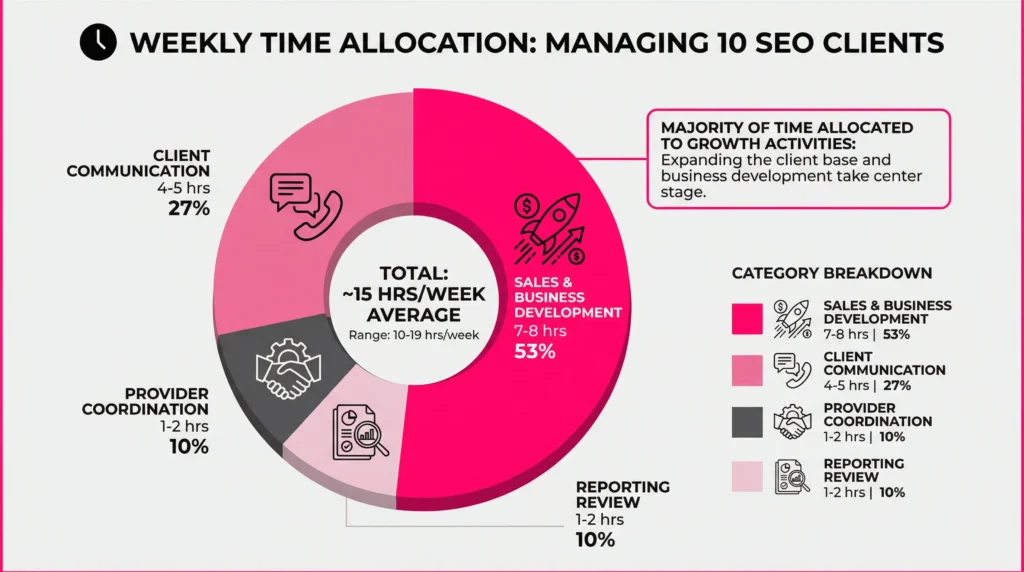
Time allocation across ten clients:
Monthly reporting review: 1-2 hours total (10-15 minutes per client checking reports for quality and accuracy).
Client communication: 3-5 hours (scheduled check-ins, answering questions, strategic guidance).
Provider coordination: 1-2 hours (submitting new client details, clarifying requirements, addressing issues).
Sales and business development: 5-10 hours (prospecting, proposals, closing new clients).
Total: 10-19 hours per week managing ten clients generating $12,000-$18,000 in monthly revenue. The remaining time goes to other service lines or additional client acquisition.
This model lets solo practitioners earn six figures annually without burning out on delivery work.
For Agencies Serving Specific Verticals
Vertical specialization creates competitive advantages. You understand your niche deeply. Your messaging resonates specifically. Your results prove industry expertise.
White label can support vertical focus or undermine it, depending on provider selection.
When vertical specialization matters:
Some industries have unique local SEO requirements that general providers handle poorly.
Healthcare: HIPAA compliance, medical schema markup, reputation management for doctor reviews, content requiring medical accuracy.
Legal: State bar restrictions on advertising, attorney schema, practice area targeting, competitive markets requiring aggressive strategies.
Multi-location franchises: Complex location hierarchy, brand consistency across locations, franchise vs corporate structure, scaled processes across dozens or hundreds of locations.
Home services: Seasonal demand fluctuations, emergency service optimization, service area vs location-based targeting, review generation at high volume.
If your vertical has unique requirements, generic white label won’t deliver optimal results. You need a provider with specific vertical experience or the flexibility to customize.
Finding providers with niche expertise:
Most white label providers serve all industries. Few specialize vertically. That’s actually okay if they’re willing to learn and adapt.
During provider evaluation, ask: “What experience do you have with [your vertical]?” and “What unique requirements have you handled for [your vertical] clients?”
If they have relevant experience, great. If they don’t, ask: “How do you typically adapt your processes for industry-specific needs?” Quality providers have systematic approaches to learning new verticals.
Some agencies develop proprietary strategies for their vertical then partner with white label for commodity execution. Example: You’ve developed a unique legal SEO methodology. The white label provider handles citation building and technical SEO. You handle strategy and legal-specific content.
Combining white label plus internal specialization:
The hybrid model often works best for vertical agencies. Use white label for standardized work. Keep specialized work in-house.
White label handles: Citations, GBP basic optimization, technical SEO, monthly reporting, link building.
Internal team handles: Vertical-specific content, strategic positioning, competitive differentiation, client consultations.
This division maximizes efficiency. You’re not paying premium prices for commodity work. You’re not wasting internal expertise on tasks that can be systematized.
It also protects your competitive moat. Your proprietary methodologies and vertical expertise stay internal. Your white label provider executes the foundation work that’s similar across all industries.
Expert Pick: Search Visibility Masters works with several agencies serving specific verticals (legal, medical, home services) by providing foundational local SEO infrastructure while the agency maintains their specialized competitive advantages. The combination performs better than either pure white label or pure in-house.
Vertical specialization and white label aren’t mutually exclusive. Done correctly, they complement each other. White label provides reliable infrastructure. Your vertical expertise provides competitive differentiation. Together they create sustainable advantage.
Common Mistakes Agencies Make with White Label Local SEO (And How to Avoid Them)
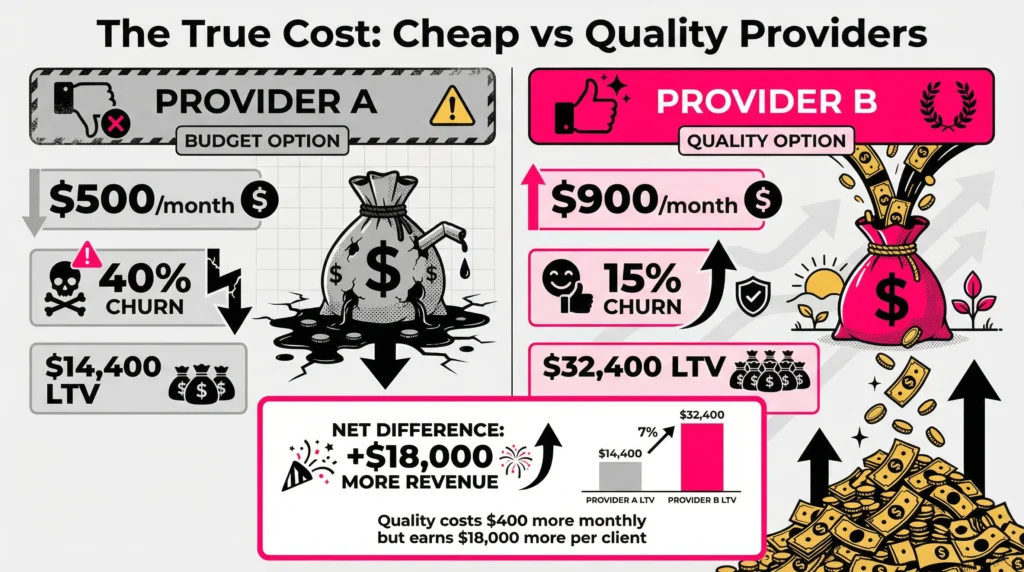
Mistake #1: Choosing Based on Price Alone
Price shopping is the fastest way to end up with a provider that costs you clients. The cheapest option almost never delivers the best results.
Why cheapest doesn’t equal best value:
Provider A charges $500/month per client. Provider B charges $900/month. The math seems simple. Provider A saves you $400 per client. At ten clients, that’s $4,000/month in extra margin.
But Provider A delivers inconsistent quality. Reporting is late or incomplete. Citations have errors. Link building uses spammy tactics. Client churn hits 40% annually because results don’t materialize.
Provider B costs more but delivers consistently. Reports arrive on schedule. Citations are accurate. Rankings improve predictably. Client retention runs 85%+ annually.
The math reverses. Provider A’s “savings” disappear when you calculate lifetime value. Losing four clients per year at $1,500/month each costs you $72,000 annually. That $48,000 in saved provider fees becomes a $24,000 net loss.
Quality providers charge more because they invest in better processes, experienced staff, enterprise tools, and systematic quality control. Those investments translate to better client retention for your agency.
Pro Tip: The right question isn’t “What’s the cheapest provider?” It’s “What’s the cost per retained client over 12 months?” Factor in your churn rate with each provider option. The provider with 90% retention at higher cost often delivers better economics than the provider with 60% retention at lower cost.
Hidden costs of poor quality:
Bad white label work creates costs beyond the monthly fee you’re saving.
Time cost: Hours spent managing problems, explaining delays to clients, reviewing subpar work, requesting corrections. Your time has value. If you’re spending 5 hours per month per client managing a problematic provider, that’s time you can’t spend selling or servicing clients.
Reputation cost: Your agency brand takes the hit when rankings don’t improve or worse, drop from black-hat tactics. Rebuilding trust after a negative experience is exponentially harder than maintaining it.
Replacement cost: Finding a new provider, migrating clients, re-onboarding, explaining the transition to clients. This disruption costs time and risks losing clients who get frustrated with the instability.
Opportunity cost: While you’re fighting fires with a bad provider, your competitors are scaling smoothly with quality providers. You’re treading water while they’re growing.
What “savings” actually costs in churn:
Industry data shows average agency client lifetime for local SEO ranges from 12-36 months depending on results quality and relationship management.
Calculate the math for your agency:
Average client pays $1,800/month. Stays for 18 months with a quality provider. Lifetime value is $32,400.
Same client with a poor provider sees minimal results. They leave after 8 months. Lifetime value drops to $14,400. You “lost” $18,000 in future revenue from that one client.
Multiply across ten clients. The difference between 18-month retention and 8-month retention is $180,000 in lost revenue. No amount of provider cost savings makes up that gap.
Did You Know? According to research from Bain & Company, increasing customer retention rates by just 5% can increase profits by 25% to 95%. For service businesses like agencies, retention matters more than almost any other metric.
Mistake #2: Failing to Vet Provider Processes
Most agencies sign with white label providers after a single sales call. They trust marketing promises instead of verifying operational reality. This lack of due diligence costs them later.
Trusting without verification:
Sales conversations paint rosy pictures. “We deliver comprehensive local SEO.” “Our processes are proven.” “We have years of experience.” All of that might be true. Or none of it.
You’re putting your client relationships and revenue in their hands. That requires verification, not blind trust.
Request documentation of their actual processes. Not marketing fluff. Actual step-by-step workflows. How do they build citations? What’s the exact process? What tools do they use? What quality checks exist?
If they say “our proprietary process” without providing specifics, that’s a red flag. Either they don’t have consistent processes, or they’re hiding tactics you wouldn’t approve of.
Not reviewing actual deliverables upfront:
Ask to see real work samples before signing. Actual reports with data (client info redacted). Actual citation profiles they’ve built. Actual content they’ve created.
Marketing materials show aspirational work. Samples show operational reality. The gap between the two reveals what you’ll actually receive.
Pay attention to details in samples. Are reports comprehensive or superficial? Is data accurate and properly sourced? Is branding truly customizable or just logo placement? Are deliverables professional or sloppy?
These samples predict your experience. If reporting is hard to read or incomplete in samples, it won’t magically improve after you sign.
Skipping reference checks:
Every provider offers to connect you with “happy clients.” Most agencies skip this step. That’s a mistake.
Call 3-5 agency references. Ask specific questions:
“What problems have you encountered, and how did the provider handle them?” This reveals how they respond under pressure.
“What almost made you leave?” Agencies rarely leave perfect providers. Understanding what frustrated them helps you know what to expect.
“How does their quality compare to your previous providers?” Context matters. If they switched from overseas to this provider, they’ll have strong opinions on the quality difference.
“How accurate is their sales pitch compared to operational reality?” Sales promises versus delivery reality. The gap here predicts your experience.
References who’ve been with the provider for 2+ years matter most. Anyone can deliver quality for six months. Sustained quality over years proves systematic capability.
Pro Tip: During reference calls, listen for hesitation or qualified answers. “They’re good… mostly” or “They’re fine if you stay on top of them” are warning signs. You want references who enthusiastically recommend without reservations.
Mistake #3: Poor Onboarding and Expectation Setting
The way you onboard clients to white label services determines whether they succeed or churn. Most agencies fail here by either over-promising or under-communicating.
Client communication gaps:
Your client doesn’t know you’re using white label. That’s fine. But they do need to understand what to expect from the service you’re selling.
Many agencies stay vague. “We’ll handle your local SEO” without explaining what that means, what timeline to expect, or what metrics matter. Vague expectations create disappointed clients even when work is being done correctly.
Be specific upfront:
“Local SEO takes 3-6 months to show meaningful results. Month one we build the foundation. Months 2-3 you’ll see initial ranking improvements. Months 4-6 momentum really builds. Most clients see their best results after 6-12 months of consistent work.”
“We track rankings in the local map pack, organic traffic from local searches, and lead volume from your Google Business Profile. These metrics show your return on investment.”
“You’ll receive monthly reports showing all work completed and results achieved. We’ll have quarterly calls to review strategy and adjust based on market changes.”
Clear expectations prevent problems. Clients know what’s coming. They know what success looks like. They know when to expect results.
Unrealistic timeline promises:
Competition for clients tempts agencies to over-promise. “We’ll get you page one rankings in 30 days!” sounds great in sales conversations. It creates massive problems in delivery.
Local SEO fundamentally takes time. Google needs to crawl updates, process new citations, evaluate new links, and observe engagement patterns. There’s no fast-forward button.
Promising unrealistic timelines sets you up for client dissatisfaction regardless of actual progress. If you promise 30 days and deliver in 90 days, the client is unhappy even though 90 days is a perfectly normal timeline.
Set realistic expectations from the beginning. “Most clients see initial movement in 60-90 days, with significant results building over 6-12 months.” Then exceed those expectations by delivering slightly faster or better.
Under-promise and over-deliver beats over-promise and under-deliver every time.
Not explaining the partnership model:
You don’t need to tell clients you’re using white label. But you should frame how your agency operates to prevent questions later.
Useful framing: “We have specialized local SEO experts on our team who focus exclusively on this work. They handle the technical execution while I manage strategy and client relationships.”
This is completely accurate. Your white label provider is infrastructure, like using Salesforce for CRM or HubSpot for marketing automation. You’re not hiding anything. You’re accurately describing your operations.
Avoid phrases like “we outsource” or “we use a third party.” That language creates doubt about your capability and control even though the actual work is identical.
If a client directly asks if work is done in-house, answer honestly but confidently. “We use specialized infrastructure for execution, similar to how we use other enterprise tools. This lets us deliver consistent quality without the overhead of building everything internally.”
Most clients never ask. They care about results, not your internal operations. But having a clear answer ready prevents awkward moments if the question arises.
Did You Know? Research from Salesforce shows that 78% of customers have backed out of a purchase due to poor customer experience. For agencies, “poor experience” often means misaligned expectations rather than actual service quality problems.
Mistake #4: No Quality Control Systems
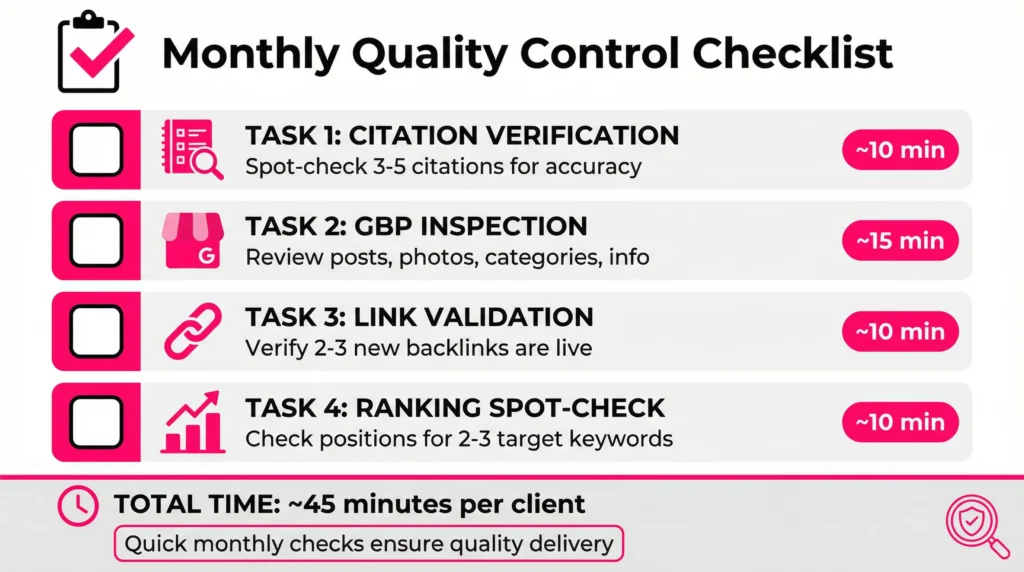
White label requires trust. But trust doesn’t mean blind acceptance of everything delivered. Quality control protects your brand and your client relationships.
Reviewing reports before forwarding:
You should spend 5-10 minutes reviewing every monthly report before your client sees it. You’re not re-doing the work. You’re spot-checking for quality and accuracy.
Check for obvious errors:
Basic accuracy: Is the client’s business name spelled correctly? Are service areas accurate? Are competitor names and URLs correct?
Data quality: Do ranking changes make sense? Are traffic numbers plausible? Do citations match what the provider claimed to build?
Brand consistency: Does your logo appear correctly? Are your brand colors used? Is any provider information visible anywhere?
Completeness: Are all promised deliverables documented? Does the report show the work that was supposed to happen?
Catching errors before your client sees them protects your reputation. Forwarding reports blindly means your client discovers problems first. That damages trust.
If you find consistent errors across multiple months, that’s a provider quality problem that needs addressing.
Spot-checking work quality:
Reports document work claimed. Spot-checking verifies work actually happened.
Monthly spot-check routine (15-20 minutes):
Citation verification: Pick 3-5 citations the provider claims to have built. Search for them. Verify they exist, are accurate, and are actually live (not just submitted).
GBP inspection: Log into your client’s Google Business Profile. Verify posts were published, photos were added, categories are optimized as promised.
Link validation: Check 2-3 new backlinks the provider claims. Do they exist? Are they from quality domains? Are they actually linking to your client?
Ranking spot-check: Use an incognito window to search for 2-3 target keywords. Do rankings roughly match what the report shows?
You’re not auditing everything. That would negate the efficiency of white label. You’re sampling enough to verify the provider is delivering what they’re claiming.
Consistent spot-checking (monthly or quarterly) catches problems early. Waiting until your client complains means the problem has already damaged your relationship.
Pro Tip: Create a simple spot-check checklist you follow monthly. Five-minute verification of key deliverables. If everything checks out consistently for 6+ months, you can reduce checking frequency. But never eliminate it entirely.
Monitoring client satisfaction signals:
Your clients tell you when something is wrong, often indirectly. Learn to read the signals.
Warning signs of dissatisfaction:
Delayed payment. Previously on-time clients start paying late or asking for payment plans. They’re questioning value.
Decreased communication. Clients who previously engaged actively stop responding to your emails or calls. They’re checked out mentally.
Specific complaints about pace. “I thought we’d be ranking by now” or “I’m not seeing the results I expected.” They’re losing confidence.
Comparison questions. “My competitor seems to be ranking better than us” or “A friend’s business saw faster results.” They’re shopping around mentally.
These signals precede cancellation by 30-90 days. Catching them early lets you address concerns before they become deal-breakers.
Addressing problems proactively:
When you spot issues (quality problems, client dissatisfaction signals, or concerning trends), address them immediately. Don’t wait and hope they resolve themselves.
With your provider: “I’ve noticed reports have been late twice in the last three months. What’s causing the delays, and how are you fixing it?”
With your client: “I wanted to check in on how you’re feeling about progress. I know results take time to build, but I want to make sure we’re aligned on expectations.”
Proactive communication demonstrates you’re monitoring quality and care about their success. Reactive communication (only responding after clients complain) signals you’re not paying attention.
Quality control isn’t micromanagement. It’s responsible brand protection. You’re ensuring the infrastructure you’re leveraging actually delivers what your clients are paying for.
Why Search Visibility Masters Built a Different Model
50+ Agencies Since 2017: What That Actually Means
Most white label providers claim to serve “many agencies” or “dozens of partners.” Vague language hides weak numbers. Search Visibility Masters serves 50+ agencies across the US, UK, Australia, and Canada. That’s not marketing language. That’s operational reality.
Not claims – actual operational scale:
Fifty active agency partners means hundreds of end clients under management simultaneously. That volume requires systematic processes, not individual heroics.
One agency staying for six years might be luck or relationship-based loyalty. Fifty agencies maintaining relationships for years proves the infrastructure works predictably.
This scale also means Search Visibility Masters has seen almost every local SEO scenario that exists. Medical practices, law firms, restaurants, home services, franchises, single locations, multi-location operations, competitive markets, emerging markets. The pattern recognition from that volume informs better strategy.
You benefit from infrastructure refined through thousands of client campaigns. Not experimental approaches that might work. Proven processes that consistently deliver.
Why agencies stay (retention focus):
White label providers typically have 40-60% annual churn. Agencies leave because of quality problems, communication breakdowns, or better alternatives emerging.
High retention rates signal the opposite. Agencies stay because switching costs them more than staying. The operational reliability, consistent quality, and relationship trust outweigh potential savings elsewhere.
Ask any white label provider: “What’s your average agency retention time, and can you share references who’ve been with you for 3+ years?” Most can’t answer. The agencies that can answer are worth serious consideration.
Search Visibility Masters has agency partners dating back to 2017 because reliability compounds over time. Year one proves capability. Year three proves consistency. Year six proves you’ve built sustainable infrastructure agencies depend on.
What infrastructure at scale enables:
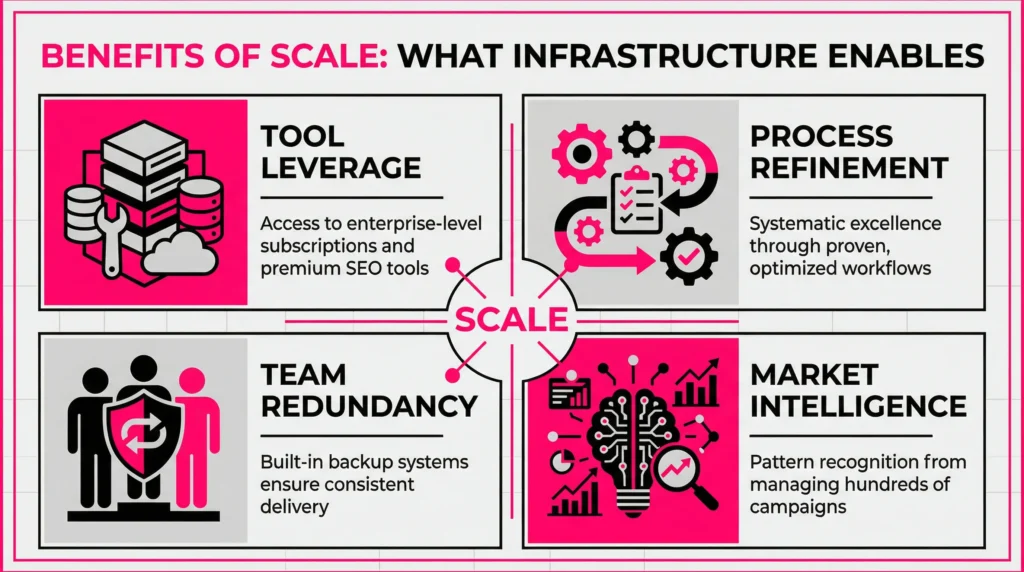
Operating at 50+ agencies creates advantages smaller providers can’t match.
Tool leverage: Enterprise subscriptions to Ahrefs, SEMrush, BrightLocal, Whitespark, Local Falcon, and other premium tools cost thousands monthly. That investment makes sense at scale but crushes margins for small operators.
Process refinement: Handling hundreds of clients reveals what works systematically versus what only works occasionally. Processes get documented, tested, and improved continuously. Small-scale operations rely on individual expertise rather than systematic excellence.
Team redundancy: One person getting sick or leaving doesn’t crater delivery when you have team depth. Scale enables backup systems and cross-training that protects against single-point failures.
Market intelligence: Seeing results across dozens of industries and hundreds of locations reveals ranking patterns, algorithm shifts, and competitive tactics faster than working in isolation.
Pro Tip: Scale matters more than most agencies realize. A provider serving 5 agencies is doing customized work per relationship. A provider serving 50+ agencies has systematized everything that can be systematized. You want the systematic approach, not the custom approach.
Agency-First Design: Not Repurposed End-Client Services
Most white label providers started as traditional SEO agencies serving direct clients. They added “white label” to their services but never rebuilt their operations for agency-specific needs.
Search Visibility Masters built exclusively for agencies from day one. That design focus shows up in every operational detail.
Standardized workflows across all accounts:
Direct client work rewards customization. Every client gets a bespoke strategy reflecting their unique needs and preferences.
Agency infrastructure rewards standardization. Every client gets the same systematic process executed to the same quality standard. Consistency matters more than creativity.
This isn’t about cutting corners. It’s about reliability at scale. You can’t deliver predictable quality across 50 agencies and hundreds of clients with ad-hoc approaches. You need documented processes that work the same way every time.
Standardization also makes onboarding faster. New clients don’t require strategy development from scratch. The proven process starts immediately.
Consistent quality regardless of volume:
Some white label providers deliver great quality when managing 10-15 total clients. Quality degrades when they hit 30+ because their processes don’t scale.
Agency-first infrastructure is designed to scale without quality degradation. The 50th client receives the same execution quality as the 1st client because the process is systematic, not personality-dependent.
This scalability protects your growth. You’re not wondering “Can my provider handle 5 more clients?” You know capacity exists because the infrastructure was built for scale.
Did You Know? According to operations research, process standardization can reduce error rates by 50-90% compared to ad-hoc execution. For agencies where every error risks client relationships, that consistency premium matters significantly.
Built for reseller operational needs:
Agency needs differ fundamentally from end client needs.
End clients want: Customization, flexibility, direct communication, strategic partnership, involvement in decisions.
Agencies want: Predictability, systematic execution, complete invisibility, consistent quality, minimal management overhead.
Search Visibility Masters optimizes for agency needs. Reports arrive on the same schedule monthly. Work follows documented processes. Provider invisibility is technically enforced, not just promised. Quality control is systematic, not random.
The entire operation exists to make agencies successful. Not to serve end clients. That focus produces better outcomes for the specific model agencies are running.
The Boring Advantage: Reliability Over Innovation
The sexiest marketing talks about innovative approaches, cutting-edge tactics, and revolutionary strategies. That’s not what makes white label infrastructure work long-term.
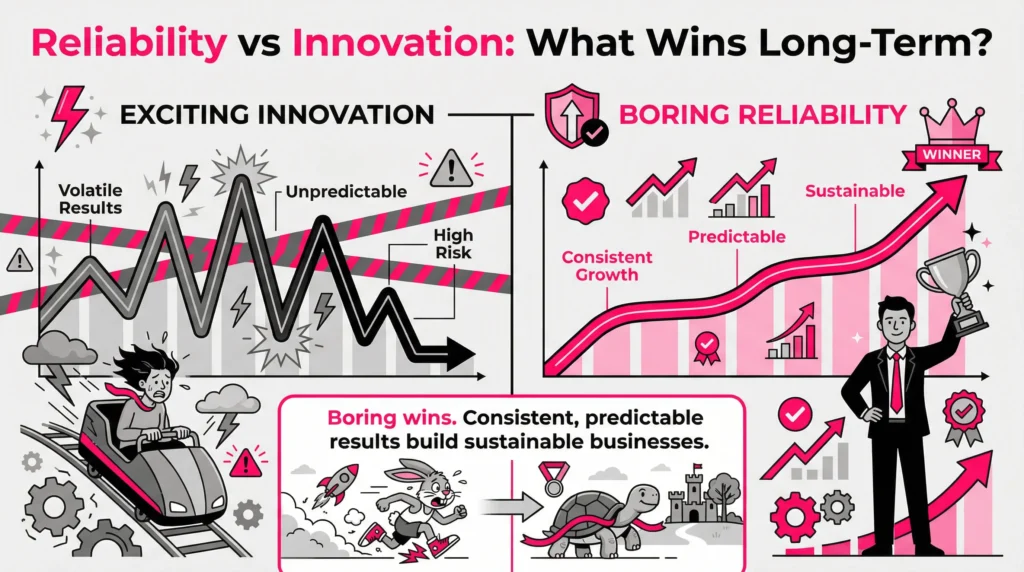
Predictable delivery:
You need to know with confidence that work will be completed on schedule to expected quality standards. Not sometimes. Every time.
Boring predictability beats exciting innovation in white label relationships. Your clients don’t care if the citation-building process is innovative. They care that rankings improve and leads increase.
Search Visibility Masters built infrastructure optimized for predictability. Same processes every month. Same quality standards every campaign. Same communication cadence every cycle.
That consistency is harder to build than it sounds. It requires documentation, training, quality control systems, and management discipline. Most providers never invest in this boring but essential infrastructure.
No surprises:
Surprises in white label relationships are almost always negative. Late reports, missed deadlines, quality issues, communication breakdowns.
The absence of surprises is the goal. Work happens as expected. Reports arrive on schedule. Quality meets standards. Communication flows predictably. Operations are boring in the best possible way.
When problems do occur (they occasionally will), you want predictable problem resolution. Clear escalation paths, defined response times, systematic debugging. Not chaos and finger-pointing.
Process over personality:
Charismatic founders and talented individuals create initial success. Systematic processes create sustainable success.
If your provider relationship depends on one account manager’s excellence, you’re vulnerable. That person leaves, gets overloaded, or burns out, and your service quality collapses.
Infrastructure built on processes survives personnel changes. The documented workflows, quality standards, and systematic operations continue regardless of who’s executing them.
Pro Tip: The best white label providers have high employee retention (less turnover means less disruption) and comprehensive documentation (new team members can maintain quality quickly). Ask providers about their employee retention rates and training systems.
Search Visibility Masters prioritizes process documentation over individual brilliance. The process catches mistakes, maintains standards, and ensures consistency. That’s less exciting than “rockstar SEO ninja” marketing but far more valuable for agencies building sustainable operations.
Infrastructure you can depend on:
The ultimate value of white label is dependability. You can confidently sell local SEO knowing it will be delivered consistently. You can scale your agency knowing capacity exists. You can sleep at night knowing your clients are being served properly.
That dependability comes from boring excellence. Systematic processes. Documented workflows. Consistent quality control. Predictable communication. Reliable problem resolution.
Innovation is exciting. Reliability is profitable. For agencies trying to build sustainable businesses, reliability wins every time.
Expert Pick: The agencies that thrive long-term with Search Visibility Masters appreciate the boring advantage. They’re not looking for exciting innovation. They’re looking for infrastructure that works the same way every month, allows them to scale predictably, and protects their brand reputation through consistent execution.
Getting Started: Next Steps for Agency Owners
Self-Assessment: Is White Label Right for Your Agency?
Before researching providers or pricing, determine whether white label fits your specific situation. Five questions reveal whether the model makes sense for your agency now.
Question 1: Can I clearly define what success looks like for a local SEO client?
If you can articulate specific outcomes (top 3 map pack rankings, X leads per month, improved visibility for target keywords), white label can deliver to that standard.
If you’re still figuring out what local SEO should accomplish or how to measure success, you need to clarify strategy before outsourcing execution.
White label providers execute your strategy. They don’t create strategy from scratch. You need to know what you’re buying before you can evaluate whether you’re getting it.
Question 2: Am I comfortable not controlling every tactical decision?
White label requires trusting the provider’s documented processes. You set the strategic direction. They execute tactics based on proven workflows.
If you need to approve every citation before it’s built, review every piece of content before publication, or sign off on every link target before outreach, white label will frustrate you. That level of control defeats the efficiency advantage.
Agencies that succeed with white label focus on outcomes (are rankings improving?) rather than tactics (exactly which directory was used for citation #47?).
Question 3: Do I have enough margin to make 40-60% profit acceptable?
White label typically delivers 40-60% margin after provider costs. If you need 80%+ margin to make your economics work, you’ll need to deliver services yourself or find a different business model.
Calculate whether 40-60% margin at scale generates sufficient profit for your agency goals. Ten clients at $700 profit each is $7,000 monthly. Twenty clients is $14,000 monthly. Does that math work for your target revenue?
Pro Tip: According to agency benchmark data from HubSpot, the average agency profit margin across all services is 10-20%. Local SEO at 40-60% margin through white label significantly outperforms average agency profitability.
Question 4: Can I commit to at least 3-6 months to evaluate a provider properly?
Month one is setup. Months two and three show initial momentum. Month six reveals whether the relationship delivers consistently.
Switching providers after 30 days because results aren’t dramatic yet guarantees failure. You’ll churn through providers, frustrate clients with constant changes, and never give any partnership time to succeed.
If you expect immediate perfection or can’t commit to a proper evaluation period, white label won’t work regardless of which provider you choose.
Question 5: Is my agency growth plan built on scaling local SEO, or is it just one small service?
If local SEO is central to your growth strategy (you plan to serve 20-50 local clients within 18 months), white label enables that scale.
If local SEO is a minor add-on service you’ll only offer occasionally (3-5 total clients), the overhead of managing a white label relationship might outweigh the benefit.
White label makes most sense when volume justifies the infrastructure investment.
Scoring your answers:
4-5 “yes” answers: White label likely fits your agency model well. Start provider evaluation now.
2-3 “yes” answers: White label might work but has meaningful limitations for your situation. Consider carefully before committing.
0-1 “yes” answers: White label probably doesn’t fit your current situation. Focus on other growth strategies or revisit this decision in 6-12 months.
What to Prepare Before Reaching Out to Providers
Proper preparation accelerates provider evaluation and prevents wasted time on bad-fit conversations. Have these elements ready before your first provider call.
Questions you’ll be asked:
Quality providers ask detailed questions to determine if your agency is a good fit. Being prepared demonstrates you’re serious and helps providers assess compatibility accurately.
About your current operations:
How many local SEO clients do you currently have? (Providers want to know your starting point and near-term growth plans.)
What services do you currently offer? (Helps them understand how local SEO fits your overall agency.)
What’s your target client profile? (Industry, size, budget range, geography.)
What made you start considering white label? (Reveals whether you’re solving a real problem or just exploring options.)
About your expectations:
What results do you expect to deliver to clients? (Tests whether your expectations are realistic.)
How involved do you want to be in day-to-day execution? (Some agencies want weekly updates. Others prefer monthly summaries. Neither is wrong, but alignment matters.)
What’s your typical client contract length? (Month-to-month vs. 6-month minimums vs. annual contracts affect the provider’s risk assessment.)
How do you handle client communication and reporting? (Providers need to understand your workflow to integrate smoothly.)
Did You Know? Research from Gartner shows that 77% of B2B buyers find the purchasing process extremely complex. Providers asking detailed qualification questions aren’t being difficult. They’re ensuring both parties succeed long-term.
Information you’ll need:
Have this information documented before provider conversations. Being organized signals you’re a professional agency they want to work with.
Current client roster: How many clients total? How many need local SEO? What industries? What locations?
Growth projections: How many new local SEO clients do you expect in the next 3, 6, and 12 months?
Service pricing: What do you currently charge (or plan to charge) clients for local SEO? This helps providers assess whether their wholesale pricing fits your model.
Technical capabilities: Do you have access to client websites for implementation? Can you coordinate technical changes if needed?
Reporting preferences: How do you currently report to clients? What format works best for your agency? How much customization do you need?
Budget constraints: What’s your target cost per client for white label services? Be realistic. If your budget is $300/month but comprehensive local SEO costs $800-$1,000, you need to adjust expectations or pricing.
How to structure initial conversations:
First provider calls should be discovery conversations, not sales pitches. Your goal is gathering information to make informed decisions.
Your agenda for the first call:
Understand their process (ask them to walk through their standard monthly workflow step-by-step).
Review actual work samples (request real reports, citation profiles, or content examples with client info redacted).
Clarify communication protocols (who’s your contact, response time expectations, escalation paths).
Discuss pricing and packages (understand what’s included at each tier and what costs extra).
Request references (agencies who’ve been clients for 2+ years specifically).
Pro Tip: Take notes during provider calls. You’ll talk to 3-5 providers during evaluation. Details blur together quickly. Documented notes help you compare objectively later.
Red flags to watch for:
Provider dominates conversation and won’t answer direct questions. (Sign they’re more focused on selling than understanding your needs.)
Vague answers about their process, client count, or capabilities. (Suggests they don’t have systematic operations.)
Pressure to sign immediately with “special pricing” that expires soon. (Quality providers don’t need high-pressure tactics.)
Unwillingness to provide references or work samples. (They’re hiding something.)
Promising unrealistic results or timelines. (Guarantees of page one rankings in 30 days are red flags.)
Timeline from Decision to First Client Onboarded
Understanding realistic timelines prevents frustration and helps you plan client conversations appropriately. Here’s what actually happens from decision to delivery.
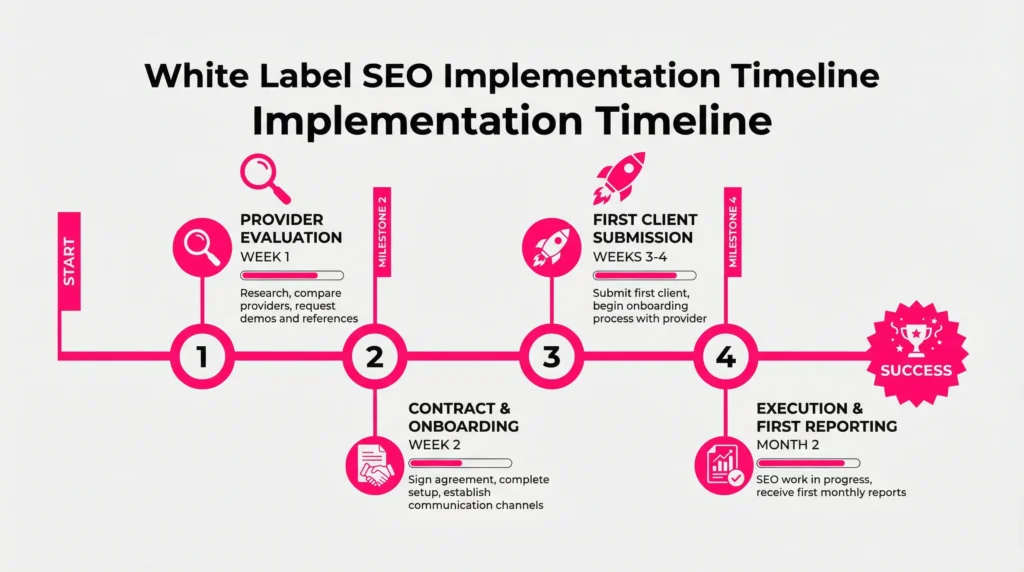
Realistic expectations:
White label isn’t instant infrastructure. But it’s dramatically faster than building in-house. Here’s the typical timeline.
Week 1: Provider evaluation and selection
You have initial calls with 3-5 providers. You check references. You review work samples. You compare pricing and capabilities.
This takes 5-10 hours of your time across the week. Don’t rush this phase. The wrong provider costs you far more than a week of evaluation time.
By end of week one, you’ve selected your provider and are ready to sign agreements.
Week 2: Contract and onboarding
You sign the provider agreement. They send onboarding documentation explaining their systems, communication protocols, and client submission process.
You receive access to their portal or system for submitting client details. You get introduced to your account manager.
This administrative setup takes 2-3 hours of your time total. By end of week two, you’re ready to submit clients.
Week 3-4: First client submission and setup
You submit your first client’s details through the provider’s intake system. They acknowledge receipt and begin onboarding.
The provider conducts their initial audit (usually 5-7 business days). They identify citation gaps, competitive landscape, technical issues, and optimization opportunities.
They share the audit results with you, often with strategic recommendations. You approve the approach and work begins.
Month 2: Execution and first reporting
The provider executes their standard first-month workflow. GBP optimization, citation building, technical fixes, initial link outreach.
You receive the first monthly report 30-35 days after client submission. You review it (10-15 minutes) and forward to your client with any additional context you want to add.
Your client sees professional deliverables, comprehensive reporting, and clear documentation of work completed.
What determines speed to value:
Some agencies onboard their first client within two weeks of signing with a provider. Others take 60+ days. The difference is usually preparation and decision speed.
Factors that accelerate timeline:
You have clients ready to onboard immediately (not “we’ll find them later”).
You’ve prepared all necessary information upfront (credentials, access, strategic direction).
You make decisions quickly (reviewing and approving audit findings within 24-48 hours, not weeks).
Your provider has capacity and starts work promptly (one benefit of choosing established providers with existing infrastructure).
Factors that slow timeline:
You need to close new clients before starting (white label doesn’t help if you don’t have anyone to onboard).
Client access issues delay things (getting website credentials, GBP ownership, or analytics access takes weeks).
You’re indecisive about approving provider recommendations (constantly second-guessing or requesting changes).
Your provider is at capacity or has long onboarding queues (more common with smaller providers).
Pro Tip: The fastest path to value is having 1-2 clients ready to onboard the week you sign with a provider. Even if results take 90 days, you’re earning revenue and learning the system immediately. Waiting to find clients means delaying revenue unnecessarily.
How fast can you actually scale:
One significant advantage of white label is scale speed. Adding clients doesn’t require hiring, training, or ramping up internal capacity.
Months 1-3: Submit and onboard your first 3-5 clients. Learn the provider’s systems. Build confidence in the relationship.
Months 4-6: If the first clients are going well, accelerate. Submit 5-10 more clients. Scale revenue while your initial clients start showing strong results.
Months 7-12: With proven results and optimized operations, most agencies can onboard 15-25 clients during this period if sales support that growth.
This scaling timeline is impossible with in-house operations. Hiring and training can’t keep pace. White label infrastructure scales as fast as your sales pipeline can feed it.
The bottleneck shifts from delivery to client acquisition. That’s exactly where you want the bottleneck to be. You control sales. You can’t control whether your new hire works out or how long training takes.
Expert Pick: Search Visibility Masters has had agency partners go from 0 to 15 local SEO clients in their first six months because delivery capacity wasn’t the limiting factor. The infrastructure existed. The only question was how fast the agency could close and onboard new business.
Conclusion: Infrastructure Over Services
White label local SEO isn’t about finding someone to do the work. It’s about finding infrastructure you can depend on as your agency scales.
The difference matters significantly. Services can be inconsistent, personality-dependent, and unreliable under pressure. Infrastructure is systematic, process-driven, and built to scale predictably.
Most agencies realize this difference too late. After they’ve churned through two or three providers. After clients have been disappointed. After margin has eroded from quality issues and rework. After growth stalled because delivery couldn’t keep pace.
The smarter path is choosing infrastructure correctly from the start. Agencies that vet properly, onboard systematically, and maintain appropriate quality control build sustainable local SEO operations that compound over years.
Search Visibility Masters serves 50+ agencies across four countries because reliability scales better than innovation. Boring consistency beats exciting experimentation when your brand reputation and client relationships are on the line.
Check best white label local SEO companies before selecting one for your clients.
Take the Next Step
Review the Framework: Understand exactly how Search Visibility Masters operates and what makes the infrastructure different. Read the White Label Framework
See What Agencies Say: Check unfiltered reviews from agencies who’ve built local SEO operations on this infrastructure.
Start a Conversation: Talk about your specific situation and whether white label fits your growth plan. No pressure, just clarity. Get Started
The agencies winning with local SEO aren’t doing anything magical. They’re using infrastructure that works predictably at scale. That infrastructure is available. The only question is whether you’ll use it.
