
An expert guide to white label local SEO for web design agencies starts with one fact most agency owners overlook: you already have everything you need to sell local SEO profitably. You control the client’s website. You have their trust. You understand their business. The only missing piece is delivery capacity, and white label fulfillment solves that without hiring a single specialist.
Key Takeaways
- Web design agencies are in a great spot to sell local SEO. They control the client’s website and have built trust. Generalist marketers don’t have this advantage.
- White label fulfillment helps agencies provide local SEO. They can do this without needing to hire more staff or develop new skills.
- Local SEO aims at improving visibility in the Map Pack. It involves optimizing Google Business Profiles, managing citations, and using local intent keywords. It does not focus on national rankings or technical audits.
- Agencies usually mark up white label local SEO services by two to three times the wholesale cost. This approach leads to strong recurring margins.
- The biggest mistake is seeing local SEO as a one-off task. It should be a monthly service instead.
The opportunity is substantial. According to a Google representative speaking at the Secrets of Local Search conference, 46% of all Google searches have local intent. Research from Think with Google shows that 76% of people who conduct a local search on their smartphone visit a business within 24 hours. Your web design clients operate local businesses. Their customers are already searching. The question is whether your agency captures that revenue or leaves it for someone else.
This is the gap white label fulfillment closes.
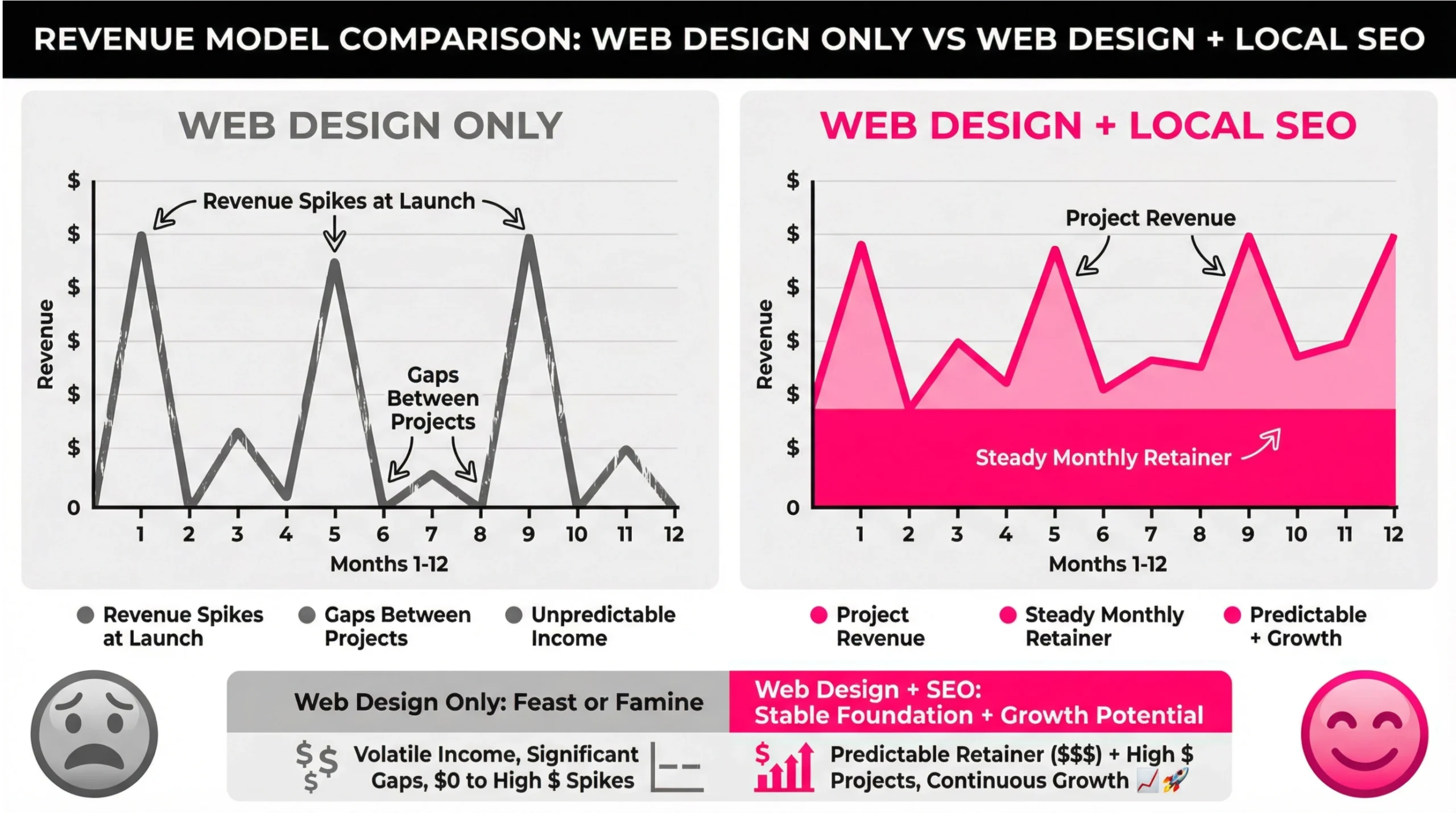
Web design agencies that only deliver websites leave recurring revenue untouched. The client pays once, launches, and disappears until their next redesign in three to five years. Adding local SEO changes that equation entirely. It creates monthly recurring revenue from clients you already have, using fulfillment partners who do the work invisibly under your brand.
This guide explains local SEO and how it differs from national SEO. It covers why white label delivery is beneficial for web design agencies. You’ll discover how to price and position your service for better profits. You’ll learn what to think about when picking a fulfillment partner. Also, you’ll find out how to avoid common mistakes that can hurt first-time SEO sellers.
Why web design agencies should add local SEO
Web design agencies already have the three key assets for selling local SEO successfully: client trust, access to websites, and technical credibility. The missing piece is delivery capacity. Agencies can earn ongoing revenue from their existing clients using white label fulfillment. This way, they avoid hiring specialists or learning new skills, all without increasing their staff.
The natural upsell from website to visibility
Clients do not pay for websites. They pay for what websites are supposed to do: generate leads, phone calls, foot traffic, or sales. A website that sits idle is not an asset. It is a line item that delivered nothing.
Web design agencies already understand this, but most stop short of solving it. They hand over a polished site, collect the final invoice, and move on. The client is left to figure out how anyone will actually find the thing.
This is where local SEO fits. It answers the question every client asks after launch, whether out loud or not: “Now what?”
The math favors recurring revenue.
Web design agencies hold three advantages over standalone SEO shops or marketing generalists. First, you already have the client relationship. Trust is established. Second, you have backend access to the website, which means you can implement technical changes without delays or handoffs. Third, you understand the client’s business well enough to position local SEO as a logical next step, not a cold pitch.
Local SEO turns a one-time project into a recurring revenue stream. A client who pays for a website and then disappears is worth one project. A client who pays for a website and adds a monthly SEO retainer is worth multiples of that initial project value over time, and more every year they stay.
This is the model agencies like Search Visibility Masters support through white label local SEO fulfillment. The agency sells and owns the client relationship. The fulfillment partner delivers the work invisibly. If you want to understand how this delivery model works in detail, the white label local SEO explained guide breaks down the mechanics.
What web design agencies get wrong about SEO
The first mistake is assuming that delivering an “SEO-friendly” website is the same as delivering SEO. It is not.
Clean code, fast load times, and proper heading structure are baseline expectations. They do not move rankings. They do not generate Map Pack visibility. They do not build citations or acquire reviews. Clients do not distinguish between “SEO-ready” and “SEO-done.” When rankings do not improve, they blame the agency, not the missing service.
The second mistake is treating SEO as a one-time add-on. Agencies often bundle a basic optimization pass into the website project, check the box, and never revisit it.
Local SEO does not work that way.
It requires ongoing attention: new reviews, updated content, citation monitoring, and competitive adjustments. According to BrightLocal’s research, 76% of marketers consider Google Business Profile management the most valuable local SEO service. That management is not a one-time task. It is continuous. Selling local SEO as a one-time deliverable sets false expectations and guarantees client dissatisfaction.
The third mistake is trying to learn and deliver SEO in-house before understanding the scope of work involved. Local SEO looks simple on the surface. Claim a Google Business Profile, add some keywords, done.
In practice, it involves citation management across dozens of directories, review acquisition systems, local link building, ongoing content updates, and constant adaptation to algorithm changes. Agencies that try to DIY this without experience burn hours, deliver poor results, and damage client relationships.
White label fulfillment exists precisely to avoid this. You sell the service. A specialist partner delivers it. Your brand stays on every report. For agencies evaluating this path, comparing providers matters. The best white label local SEO companies guide covers what to look for and how top providers differ.
What local SEO actually is (and what it is not)
Agencies that mix local SEO with technical SEO or national link building can confuse clients. They often overpromise results. Local SEO targets geographic searches. It aims to improve Map Pack visibility and optimise Google Business Profiles. Understanding what it includes, and what it does not, prevents scope creep and sets accurate client expectations.
Local SEO versus national or technical SEO
Local SEO targets searches with geographic intent. These are queries like “plumber near me,” “dentist in Austin,” or “emergency locksmith downtown.” The searcher is looking for a business in a specific location, usually with immediate intent to call, visit, or buy.
The goal is visibility in three places: the Google Map Pack (the top three local results with the map), the local finder (the expanded list users see when they click “more places”), and localized organic results below the map.
Ranking nationally for broad keywords is not the objective. Showing up when a nearby customer searches is.
This distinction matters because many agencies conflate local SEO with technical SEO or link building campaigns. Technical SEO addresses site architecture, crawlability, page speed, and indexing. It is necessary but not sufficient for local visibility.
Link building for national authority targets high-domain-authority backlinks to boost organic rankings broadly. Local SEO uses a different playbook: Google Business Profile optimization, local citations, reviews, and geographic relevance signals.
Agencies that pitch “SEO” without specifying local versus national often confuse clients and overpromise results. A local plumber does not need to rank for “plumbing tips.” They need to appear when someone five miles away searches “plumber near me” at 10 PM with a burst pipe.
That specificity is what makes local SEO valuable.
Core components of local SEO delivery
Local SEO delivery breaks down into five primary workstreams.
Google Business Profile setup and optimization is the foundation. This includes claiming or creating the profile, selecting accurate categories, writing a keyword-informed business description, uploading quality images, setting service areas, and maintaining accurate hours. GBP is the single most influential factor in Map Pack rankings.
NAP consistency and citation building come next. NAP stands for name, address, and phone number. Local SEO requires this information to be identical across the client’s website, Google Business Profile, and dozens of directories like Yelp, Bing Places, Apple Maps, and industry-specific listings.
Inconsistent NAP data confuses search engines and weakens local authority.
Review acquisition and reputation management directly impact rankings and conversions. Businesses with more reviews, higher average ratings, and recent review activity outperform competitors in local results. A delivery system for requesting, monitoring, and responding to reviews is essential.
Localized on-page content optimization means structuring website pages to target local intent keywords. This includes location-specific title tags, headers, and body content. Service pages should reference the cities or neighborhoods the business serves, not just generic service descriptions.
Local link building and authority signals round out the strategy. Links from local news sites, chambers of commerce, sponsorships, and community organizations signal geographic relevance. These carry more weight for local rankings than generic backlinks from unrelated sites.
Each of these workstreams requires ongoing attention, not one-time execution.
How search engines evaluate local businesses
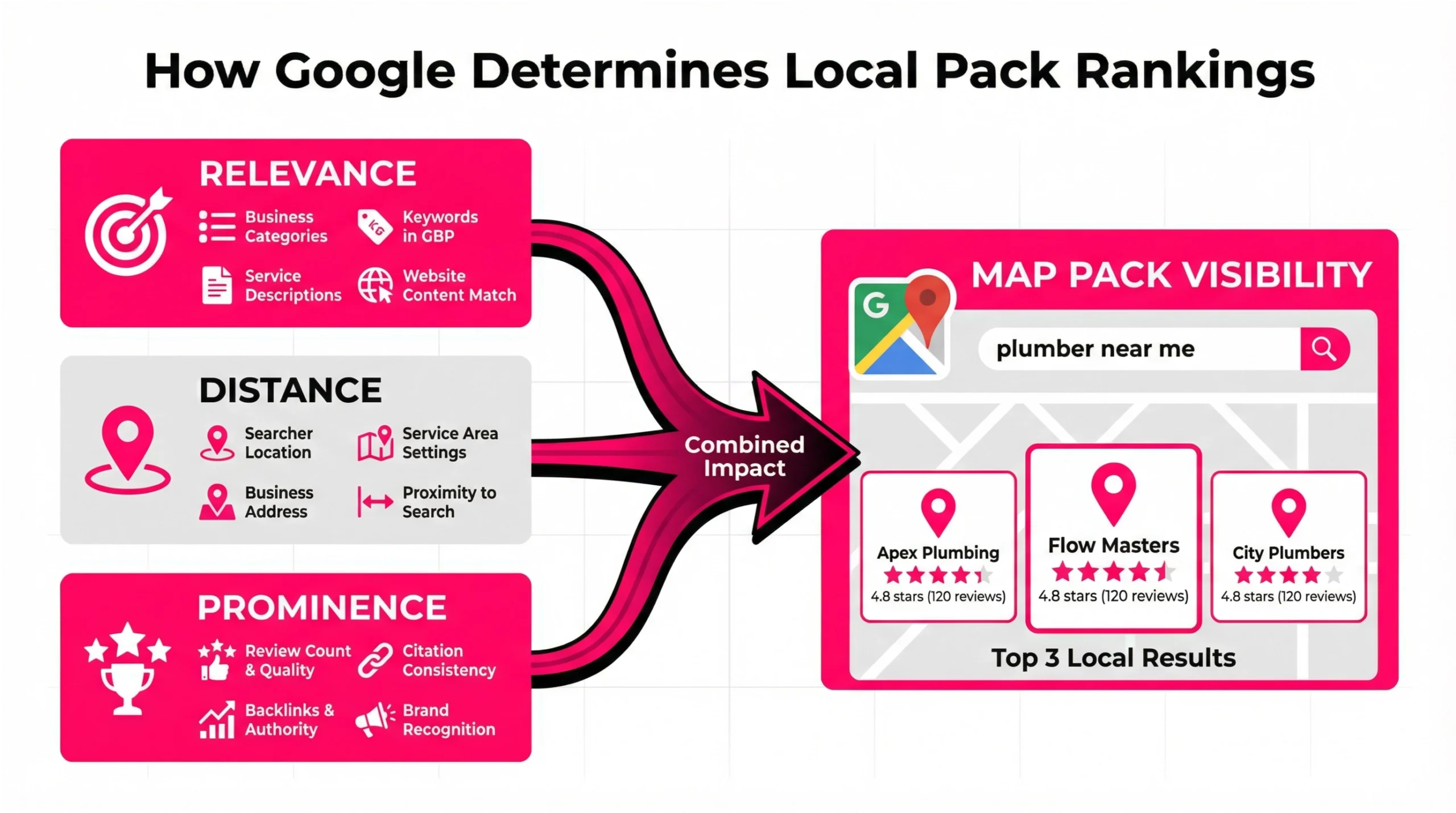
Google’s official documentation states that local results are based on three factors: relevance, distance, and prominence.
Relevance measures how well a business profile matches the search query. A complete and accurate Google Business Profile with detailed service information ranks better than a sparse listing. Choosing the right primary and secondary categories matters significantly here.
Distance is straightforward. Google considers how far each potential result is from the location term used in the search, or from the user’s detected location if no specific area is mentioned.
A business ten miles away will struggle to appear for “near me” searches unless competition is extremely low.
Prominence reflects how well-known and authoritative a business is. Google measures this through review count and score, citation volume, backlink profile, and overall web presence. A business with 200 reviews and listings on 50 directories will typically outrank a competitor with 10 reviews and a handful of citations.
Behavioral signals also influence rankings, though Google is less explicit about these. Clicks on the listing, calls initiated from the profile, direction requests, and website visits all indicate user engagement. Profiles that generate action tend to maintain or improve their positions over time.
Review velocity matters more than many agencies realize.
The rate at which new reviews come in signals ongoing customer activity. A business that received 30 reviews two years ago but nothing since may lose ground to a competitor with steady monthly review flow. According to BrightLocal’s research, 76% of marketers consider Google Business Profile management the most valuable local SEO service precisely because it influences all three ranking factors.
Why white label is the delivery model that makes sense
Agencies face three options when adding local SEO: build internal capacity, buy tools and figure it out, or partner with a white label provider. Building requires hiring, training, and ongoing management. Buying tools alone does not create delivery expertise. Partnering turns sales into the only constraint on growth while keeping margins healthy.
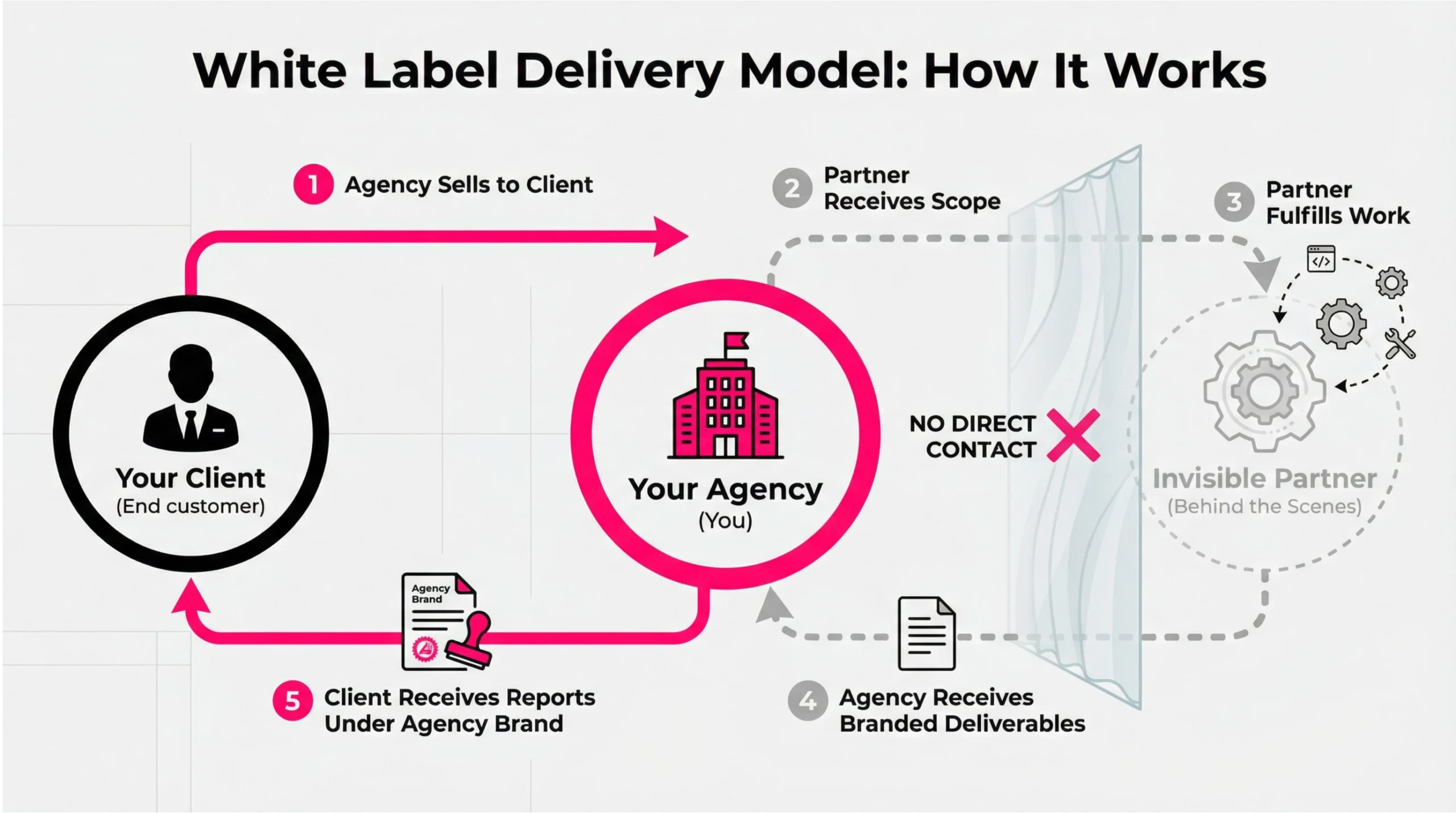
Build versus buy versus partner
Web design agencies considering local SEO have three paths. Each has different cost structures, risk profiles, and timelines.
Building in-house means hiring SEO specialists, purchasing tools, developing processes, and training staff. This path offers maximum control but requires significant upfront investment.
The numbers add up quickly.
According to Glassdoor, the average SEO specialist salary in the United States is $85,368 per year, with the typical range falling between $64,475 and $113,859 depending on experience and location. Add tools and the costs climb further. Semrush Pro starts at $139.95 per month, while the Guru plan runs $249.95 per month. BrightLocal, a local SEO specific platform, costs $29 to $44 per month depending on features. A basic tool stack runs $2,000 to $4,000 annually. A comprehensive one costs more.
Building makes sense for agencies with predictable SEO volume exceeding 20 or 30 clients and a long-term commitment to making SEO a core competency. For agencies testing the service or operating with lean teams, building is the slowest and riskiest path.
Buying tools without dedicated staff is the second option. Agencies purchase SEO software and attempt to deliver services using existing team members, often designers or project managers, in their spare time.
This rarely works.
Local SEO is not a side task. It requires consistent attention, specialized knowledge, and time that already-busy staff do not have. The result is inconsistent delivery, missed optimizations, and client churn.
Partnering through white label fulfillment is the third path. A specialized provider handles all delivery under your agency’s brand. You sell the service, set pricing, and own the client relationship. The partner executes the work, provides branded reports, and remains invisible to your clients.
This model turns sales capacity into the only constraint on growth. You do not need to hire before you sell. You do not need to train before you deliver. Onboarding with a capable white label partner like Search Visibility Masters takes days, not months. The agency scales revenue without scaling headcount.
What white label local SEO actually includes
White label local SEO is not a stripped-down version of the real thing. A capable fulfillment partner delivers the same services an in-house team would, just without the overhead.
Branded audits and strategy documents come first. Before optimization begins, the partner audits the client’s current local presence: Google Business Profile completeness, citation accuracy, review profile, on-page local signals, and competitor positioning. This audit, delivered under your agency’s brand, becomes both a diagnostic tool and a sales asset.
Google Business Profile management is ongoing. This includes profile optimization, category selection, photo uploads, post scheduling, Q&A monitoring, and attribute management. GBP is the most important ranking factor for Map Pack visibility, so continuous attention matters.
Every element of delivery carries your brand, not the partner’s.
Citation building and cleanup ensure NAP consistency across directories. The partner submits the business to relevant local and industry directories, corrects inconsistencies, and monitors for duplicate or outdated listings. This work is tedious and time-consuming, exactly the kind of task agencies should not handle manually.
Review acquisition systems help clients generate new reviews consistently. This may include email or SMS sequences, review request landing pages, and monitoring dashboards. The partner provides the infrastructure. The agency provides the client relationship that makes review requests effective.
Ongoing reporting ties everything together. White label reports show ranking changes, GBP performance metrics, citation status, and review trends, all branded to your agency. Clients see your logo, your colors, and your name. The fulfillment partner stays invisible.
Search Visibility Masters structures delivery around a documented framework that agencies can review before partnering. This transparency helps agencies evaluate fit and set client expectations accurately.
What agencies should expect from a white label partner
Not all white label providers operate the same way. Agencies should establish clear expectations before signing.
Full invisibility to the end client is non-negotiable. The partner should never contact your client directly, include their branding on deliverables, or appear in any client-facing communication. If a provider wants co-branding or direct client access, walk away. That is not white label. That is lead generation disguised as partnership.
Transparency matters at every stage.
Transparent wholesale pricing allows you to set margins confidently. You should know exactly what each service costs so you can price your packages profitably. Hidden fees, vague scopes, or pricing that changes mid-engagement erode trust and margins.
Predictable delivery timelines let you set client expectations accurately. A good partner provides clear SLAs: how long audits take, when citations go live, how quickly reports are delivered. Agencies that cannot answer “when will this be done” look unprepared to clients.
Direct communication with a dedicated account manager prevents delays and miscommunication. You should not submit tickets into a void and hope for answers. A named contact who knows your clients and responds quickly is essential.
Agencies evaluating partners benefit from checking references and reviews. Search Visibility Masters publishes agency testimonials for this reason. Hearing from agencies already using the service reveals what sales materials cannot.
How to price and position local SEO for web design clients
Pricing local SEO incorrectly is one of the fastest ways to kill margins or lose clients. Agencies that underprice attract demanding, price-sensitive buyers who churn fastest. Agencies that overprice without demonstrating value struggle to close. The goal is pricing that supports quality fulfillment while leaving room for sustainable profit.
Typical pricing structures
Local SEO pricing for small and mid-sized businesses typically falls into three models: one-time setup fees, monthly retainers, and tiered packages. Most agencies combine elements of all three.
One-time setup fees cover initial optimization work. This includes Google Business Profile setup or optimization, initial citation submissions, on-page local SEO adjustments, and a baseline audit. Setup fees commonly range from $500 to $2,000 depending on scope and competition level. This fee is separate from the website project cost and should be positioned as the bridge between “site live” and “site visible.”
Monthly retainers cover ongoing optimization. This is where recurring revenue lives.
According to a 2025 survey by SE Ranking, 64% of SEO agencies charge less than $1,000 per month for retainer services, with the $500 to $1,000 range being the most common. For local SEO specifically, small businesses typically pay between $400 and $2,500 per month depending on competition, location count, and service scope. Retainers fund continued GBP management, citation monitoring and cleanup, review acquisition efforts, content updates, and monthly reporting.
Tiered packages simplify the sales conversation. Instead of custom-quoting every prospect, agencies offer three defined packages at set price points.
A basic package might include GBP optimization and citation building. A mid-tier package adds review management and monthly reporting. A premium package includes local content creation, local link building, and expanded reporting. Tiered pricing reduces friction in the sales process and lets clients self-select based on budget.
Agencies new to local SEO often underprice to win early clients. This is a mistake. Low pricing attracts price-sensitive clients who churn fastest and complain loudest. It also compresses margins to the point where quality fulfillment becomes impossible. Price for value delivered, not for what feels safe.
Margin expectations
White label fulfillment enables strong margins because you are not paying salaries, tools, or training. You pay wholesale for completed work and sell at retail.
Many agencies mark up white label local SEO services two to three times the wholesale cost. If your fulfillment partner charges $300 per month for a single-location local SEO package, you might sell that service for $600 to $900 per month. The difference is margin.
The math scales quickly.
Consider a practical example. An agency sells ten local SEO retainers at $750 per month with a wholesale fulfillment cost of $300 per month each. Monthly revenue is $7,500. Monthly fulfillment cost is $3,000. Gross margin is $4,500 per month, or $54,000 annually, from just ten clients. That margin comes without adding staff, buying tools, or managing SEO delivery internally.
Margins on setup fees follow the same logic. If the partner charges $400 for initial optimization and you sell it at $1,000, you keep $600 per client before the retainer even begins.
The key is knowing your fulfillment costs precisely before setting prices. Agencies that guess pricing or match competitor rates without knowing their costs often have margins that are too thin. This makes it hard to maintain quality or grow.
Search Visibility Masters offers clear wholesale pricing. This helps agencies model their margins before making a commitment. This clarity prevents the most common pricing mistakes.
Positioning local SEO alongside web design
Local SEO works best when seen as a natural step in the website project, not as a separate product introduced from the beginning.
Frame the service around outcomes. The client did not buy a website. They bought visibility, leads, or sales. The website is the foundation. Local SEO is what makes the foundation produce results. When you present it this way, local SEO becomes an expected next step rather than an optional add-on.
The post-launch moment is the highest-leverage sales opportunity.
The client is engaged. They just invested significantly in their web presence. They are thinking about results. This is when you introduce local SEO, not three months later when they have moved on mentally.
Bundle initial optimization into website proposals when possible. Adding a GBP setup and citation foundation package to the website boosts project value. This makes the shift to an ongoing SEO retainer feel smooth. The client is already saying yes. Adding a visibility component requires less convincing than a cold pitch later.
Position the retainer as protection for their investment. A website without ongoing SEO is a depreciating asset. Competitors will optimize. Search algorithms will change. Reviews will matter more. The retainer is not an expense. It is maintenance that preserves and grows the value of what they already paid for.
Avoid selling local SEO as a technical service.
Clients do not care about citations, NAP consistency, or GBP attributes. They care about phone calls, foot traffic, and leads. Translate every deliverable into client outcomes. “We will build 50 citations” means nothing. “We will make sure customers in your area find you before your competitors” means everything.
Agencies that provide both white label web design and local SEO with one partner make operations easier. Search Visibility Masters offers both services. This lets agencies bundle website and SEO delivery with one partner, so they don’t have to manage multiple vendors.
What to look for in a white label local SEO partner
Not all white label providers deliver the same quality. Some overpromise and underdeliver. Others use outdated tactics that put client rankings at risk. Choosing the wrong partner damages client relationships and forces agencies to start over with a new vendor mid-engagement.
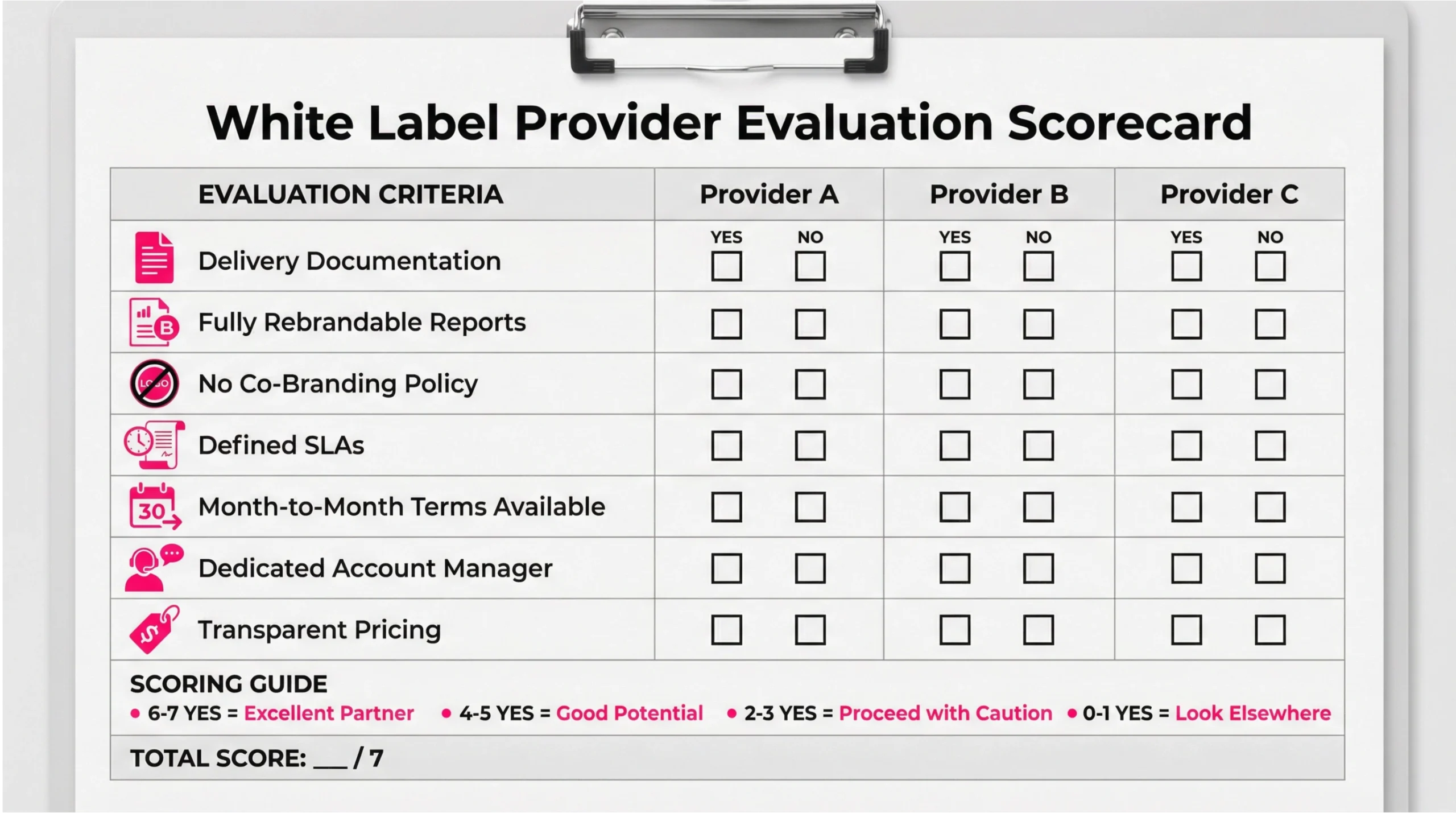
Delivery quality signals
Choosing a white label partner is a business decision with long-term consequences. The partner you select will determine client satisfaction, retention, and your agency’s reputation. Vetting properly upfront prevents painful exits later.
Clear documentation of processes and deliverables is the first quality signal. A capable partner can explain exactly what they do, when they do it, and how they measure success. If the answer to “what does your monthly local SEO service include?” is vague or shifts depending on who you ask, that is a sign of inconsistent delivery.
Look for partners who publish their methodology openly, like the framework documentation Search Visibility Masters provides.
Transparent reporting you can rebrand is essential. Reports are what clients see. If you cannot white label them completely, your partner’s brand leaks into your client relationships. Ask for sample reports before signing. Confirm that logos, colors, and contact information can be fully replaced with your agency’s branding.
Reports should also be understandable to non-technical clients, not just data dumps that require interpretation.
No co-branding or direct client contact should be standard policy. The entire point of white label is invisibility. If the partner wants their logo on reports, asks to join client calls, or sends communications directly to your clients, they are not a white label provider. They are a referral partner or lead generator using your agency for distribution.
Defined turnaround times separate professional operations from disorganized ones. You should know exactly how long each deliverable takes. GBP optimization within five business days. Citations submitted within two weeks. Monthly reports delivered by the fifth of each month. Clear SLAs let you set accurate client expectations and hold the partner accountable when timelines slip.
Red flags to avoid
Some warning signs should disqualify a partner immediately. Others are subtler but equally damaging over time.
Providers who promise specific rankings are either lying or using tactics that will eventually backfire. No one can guarantee a number-one Map Pack position. Google’s algorithm considers factors outside any provider’s control, including competitor activity, user behavior, and proximity.
Agencies that fall for ranking guarantees set themselves up for client disappointment and reputation damage.
Vague deliverables or black-box reporting hide either incompetence or corner-cutting. If a partner cannot itemize what they do each month, they probably are not doing much. “We handle your local SEO” is not a deliverable. “We optimize your GBP, build 20 citations, respond to reviews, and publish two local posts” is. Specificity enables accountability.
Long-term contracts with no performance accountability protect the provider, not you. Locking into a 12-month agreement with a partner you have never tested is high risk. Look for month-to-month arrangements or short trial periods. Confident providers do not need contracts to retain clients. They retain clients by delivering results.
Citation networks using low-quality or spammy directories hurt more than they help.
Not all citations carry equal weight. Listings on irrelevant, low-authority, or known spam directories can trigger penalties or simply waste effort. Ask the partner which directories they use. If they cannot provide a list or the list includes sites you have never heard of, investigate further.
Slow or evasive communication during the sales process predicts slow or evasive communication after you sign. If getting answers takes days before they have your money, expect worse after. Responsiveness is a quality signal. Treat it as such.
Questions to ask before signing
A short list of direct questions will reveal more than any sales presentation. Use these in your evaluation calls.
Q: What does the onboarding process look like?
A structured onboarding with clear steps, defined timelines, and a named point of contact signals operational maturity. Improvised or vague onboarding suggests you will be figuring things out together, at your expense.
Q: How are deliverables communicated?
You need to know when work is completed, what was done, and how to access reports. Some partners use dashboards. Others send email summaries. The format matters less than consistency. If you have to chase updates, you will waste time and look unprepared to clients.
Q: What happens if a client cancels?
Understand the exit process. Can you stop service immediately or is there a notice period? Are there cancellation fees? Who owns the work product, citations, and GBP access after termination? Clean exits protect both parties.
Q: Can I see sample reports?
Never sign without reviewing actual report samples. Confirm they can be fully rebranded. Assess whether the metrics and format will make sense to your clients. If the reports require heavy editing before you can send them, factor that labor into your margin calculations.
Q: How do you handle communication during delivery?
Clarify whether you will have a dedicated account manager or rotate through a support queue. Dedicated contacts build relationship continuity and reduce repetition. Ticket-based support works for simple issues but fails when nuance or context matters.
Agencies evaluating multiple providers benefit from structured comparison. The best white label local SEO companies guide offers criteria for side-by-side evaluation and identifies what separates strong partners from weak ones.
Common mistakes web design agencies make with local SEO
Most agencies that fail with local SEO make the same predictable errors. They sell to the wrong clients, price too low to afford quality fulfillment, treat ongoing work as a one-time project, or ignore emerging search surfaces like AI answers. These mistakes are avoidable once you know what to watch for.
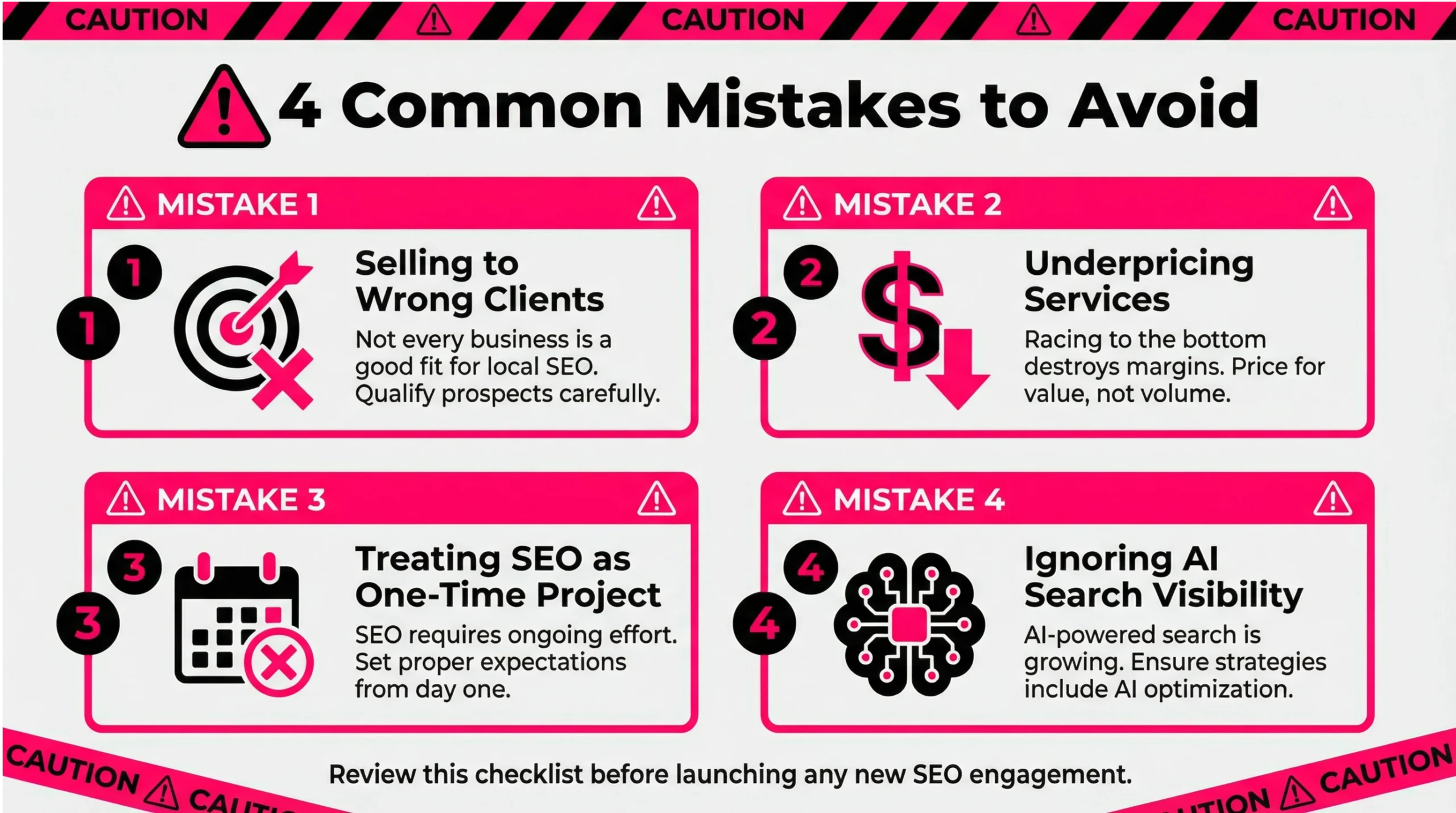
Selling local SEO to clients who do not need it
Local SEO is powerful, but it is not universal. Agencies eager to add recurring revenue sometimes pitch local SEO to clients who will never benefit from it. This wastes effort, damages credibility, and creates churn.
Local SEO works for businesses that serve customers in a defined geographic area. This includes service-area businesses like plumbers, electricians, HVAC contractors, and cleaning companies. It includes brick-and-mortar retailers, restaurants, dental practices, law firms, and medical clinics. These businesses depend on customers finding them through local searches.
Not every client fits this profile.
Local SEO does not work for ecommerce brands selling nationally or internationally. A Shopify store shipping products across the country has no use for Map Pack visibility. It needs product page optimization, technical SEO, and content strategy, not citation building. Agencies offering Shopify development should recognize when clients need ecommerce SEO rather than local SEO. These are different disciplines with different deliverables.
Local SEO also underperforms for businesses with no physical location or service area relevance. A SaaS company, a remote consulting firm, or an online course creator will not benefit from Google Business Profile optimization. Pitching local SEO to these clients reveals a lack of understanding and erodes trust.
Before proposing local SEO, confirm the client meets two criteria. First, their customers search with local intent. Second, geographic proximity matters to the buying decision. If both are true, local SEO fits. If not, recommend something else or refer out.
Underpricing or underdelivering
New agencies often underprice local SEO to win their first clients. The logic seems sound: lower prices reduce buyer hesitation and build a client base quickly.
In practice, underpricing creates a trap.
Low prices attract price-sensitive clients. These clients expect more, complain more, and leave faster than clients who pay market rates. They also refer other price-sensitive clients, compounding the problem.
Low prices also compress margins to the point where quality delivery becomes impossible. If you charge $300 a month and your fulfillment cost is $250, you have $50 remaining. This covers client communication, reporting, issue resolution, and profit. That math does not work. Something will break, usually service quality.
Underdelivering follows underpricing. Agencies with thin margins cut corners. They skip citation monitoring. They send reports without reviewing them. They stop proactive communication. Clients notice. Results suffer. Churn accelerates.
The fix is pricing for sustainability from the start.
Know your fulfillment cost. Add margin for communication, account management, and profit. Price at that number, not below it. Clients who cannot afford proper local SEO are not your clients.
Agencies working with a white label partner like Search Visibility Masters receive transparent wholesale pricing, which makes margin planning straightforward. You know exactly what delivery costs before you quote. No guessing, no unpleasant surprises.
Treating local SEO as a one-time project
Web design agencies are conditioned to think in projects. A website has a start date, a scope, a launch, and a final invoice. Local SEO does not work this way.
Agencies that sell local SEO as a one-time setup create two problems.
First, they leave recurring revenue on the table. The setup fee might be $1,000. The monthly retainer could have been $750. Over a year, that retainer is worth $9,000, nine times the setup fee. Walking away after setup is walking away from the majority of the revenue opportunity.
Second, one-time setups produce temporary results. Local SEO requires ongoing work. Reviews need continuous acquisition. Citations drift out of sync over time. Competitors optimize. Google updates its algorithm. A business optimized once and then ignored will lose ground within months.
Clients who buy one-time setups often return unhappy.
“You did SEO and it stopped working.” They do not understand that SEO is maintenance, not a fix. The agency that sold it as a project, not a service, is responsible for that misunderstanding.
Position local SEO as a retainer from the beginning. Frame the setup as onboarding, not the entire engagement. Explain that visibility requires ongoing work, just like maintaining a vehicle. The initial optimization gets things running. The monthly service keeps them running.
If a client insists on a one-time engagement, set expectations clearly in writing. Document that results will degrade without ongoing optimization. Specify that competitors will continue investing while they do not. This protects your reputation when rankings slip six months later.
Ignoring AI and answer engine visibility
Most agencies focus exclusively on traditional search: Google’s ten blue links and the Map Pack. This made sense five years ago. It is increasingly incomplete today.
AI-powered answer engines like ChatGPT, Perplexity, and Google’s AI Overviews now surface local business information directly. Users ask conversational questions and receive direct answers, often without clicking through to a website or a Google Business Profile.
The shift is accelerating faster than most agencies realize.
According to research from Local Falcon, Google AI Overviews now appear in 40.2% of local searches. A 2025 study by SE Ranking found that AI-driven referral traffic has grown more than seven times since 2024, with ChatGPT accounting for nearly 78% of all AI search traffic. These platforms pull business details from Google Maps, directories, and structured data across the web.
Agencies that optimize only for traditional search miss these emerging traffic sources.
The same NAP consistency and citation accuracy that drive Map Pack rankings also feed AI systems. Review content influences how AI describes a business. Clear, factual website content helps AI understand what the business does and who it serves. Structured data and schema markup make information easier for AI platforms to parse and cite.
Agencies do not need to overhaul their entire approach. But they should recognize that local SEO signals increasingly influence visibility beyond traditional search results. Optimizing for Google today also lays groundwork for AI visibility tomorrow.
White label partners with forward-looking delivery models already incorporate these considerations. Agencies using old playbooks or partners stuck on legacy tactics will find it hard to keep client results as search changes.
The white label local SEO explained guide covers how delivery has evolved to address these shifts and what agencies should expect from modern fulfillment.
How to sell local SEO to existing web design clients
The easiest local SEO sales come from clients you already have. They trust your agency, they just invested in a website, and they are thinking about results. The challenge is timing the conversation correctly and handling objections without losing momentum.
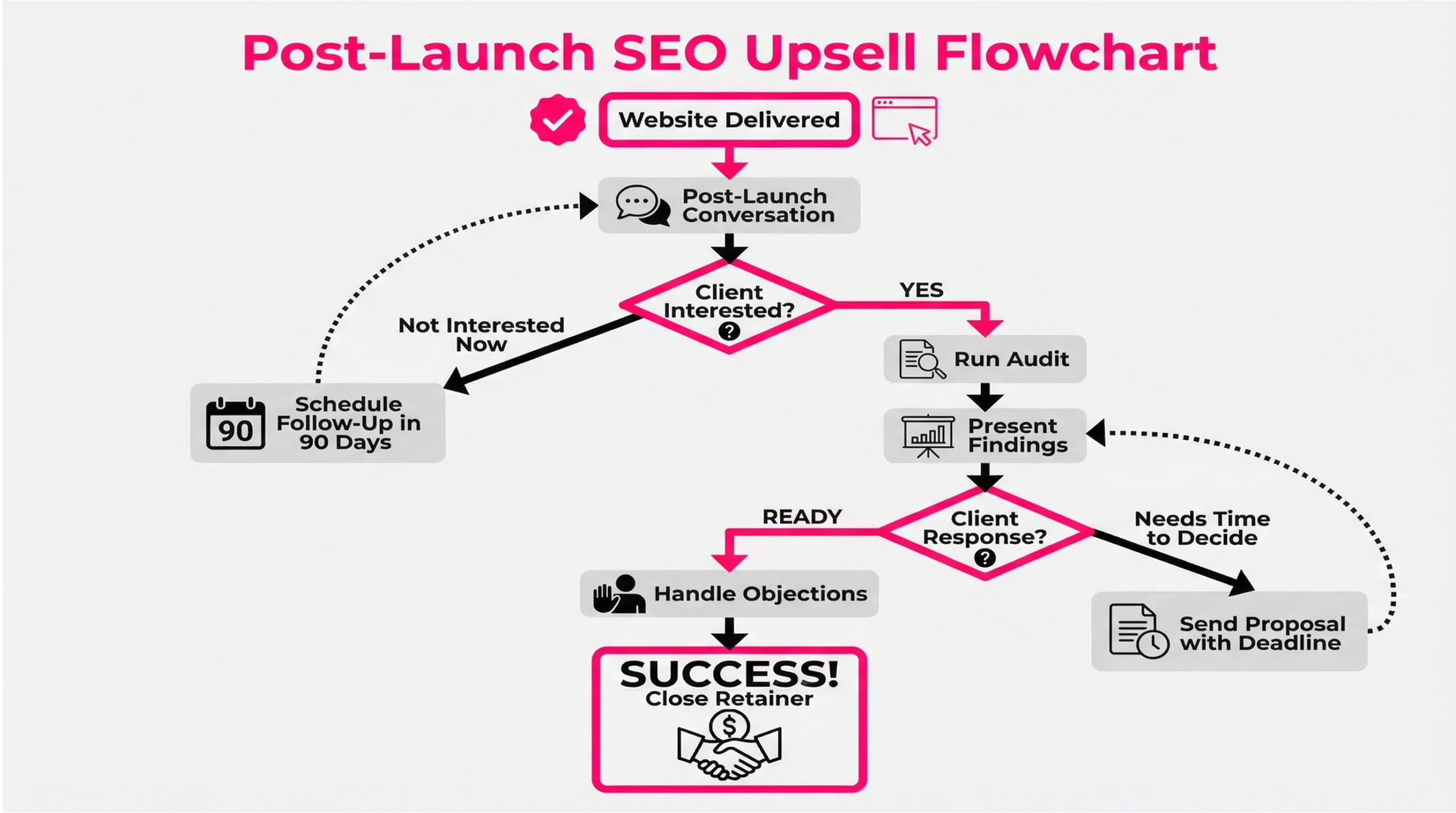
The post-launch conversation
The best time to sell local SEO is immediately after delivering a website. The client is engaged, invested, and thinking about results. They just wrote a significant check for their digital presence. The question “how will people actually find this?” is already in their mind, even if they have not asked it out loud.
Most web design agencies miss this window.
They deliver the site, send the final invoice, and move on to the next project. The client is left to figure out visibility on their own. Three months later, when they realize the new site is not generating leads, they blame the agency, find a competitor, or give up on digital entirely.
Reframe the handoff conversation. Instead of “your site is live, we’re done,” try “your site is live, now let’s make sure people find it.” This positions local SEO as the logical next step, not an upsell bolted on awkwardly.
The transition script is simple.
“The website looks great and is built to convert. The next step is making sure it shows up when your customers search. Most of your competitors are already investing in local visibility, which is why they appear in the Map Pack. We offer an ongoing visibility service that keeps you competitive. Want me to run a quick audit so you can see where you stand?”
This approach does three things. It validates the website investment. It introduces competitive pressure without fear-mongering. It offers a low-commitment next step, the audit, instead of asking for an immediate retainer decision.
Agencies that include this conversation in their delivery process convert more clients to retainers. This is better than those that pitch SEO as a separate product weeks or months later.
Using audit reports as a sales tool
An audit answers the question every prospective SEO client has: “What’s wrong with my current situation?” It shows gaps visually, makes the problem concrete, and positions your agency as the one who identified it.
Local SEO audits check how complete your Google Business Profile is. They look at citation accuracy in major directories, review profile strength, on-page local signals, and how you stack up against competitors. A well-structured audit produces a report the client can understand without technical expertise.
This is where white label partnerships pay off before the retainer even starts.
White label partners typically provide audit tools agencies can use in sales conversations. Search Visibility Masters includes audit capabilities that produce branded reports ready for client presentation. The agency runs the audit, reviews the findings, and presents them as their own work.
Audits are effective sales tools. They change the talk from general ideas, like “you need SEO,” to specific issues. For example, “your GBP is missing five key fields, your NAP is inconsistent across 12 directories, and your main competitor has 147 more reviews than you.” Specificity creates urgency. Clients act on concrete problems faster than vague recommendations.
Offer audits selectively.
Running free audits for every lead burns time without return. Reserve audits for qualified prospects who have expressed interest, have budget capacity, and operate businesses that genuinely benefit from local SEO. The audit is a closing tool, not a lead generation gimmick.
Present audit findings in a brief call, not a lengthy document sent via email. Walking through the report lets you explain implications, answer questions, and transition directly into a proposal. An emailed audit often goes unread or gets forwarded to someone who lacks context.
End every audit presentation with a clear next step. “Based on what we found, here’s the package I recommend. It addresses the GBP gaps, cleans up your citations, and puts a review system in place. Want me to send over the proposal?” Direct asks close deals. Vague follow-ups do not.
Handling objections
Clients raise predictable objections to local SEO. Preparing responses in advance prevents fumbling during sales conversations. Here are the most common objections and how to address them.
Q: “We already rank.”
This objection usually means the client searched their own business name and saw themselves appear. That is not ranking. That is baseline brand visibility.
The relevant question is whether they appear for non-branded searches, keywords where customers do not already know their name. Ask: “When someone searches ‘plumber near me’ or ’emergency plumber [city],’ do you show up in the top three? Let’s check.” Often, they do not. The audit provides evidence.
Q: “We get enough business.”
This sounds like a closed door, but it is actually an opening.
Ask: “How many calls per month come from your website or Google listing?” Most clients do not know. Follow up with: “If you knew you were missing 20 or 30 qualified searches per month, would that change your thinking?” Quantifying missed opportunity reframes “enough” as “less than possible.”
Q: “SEO takes too long.”
This objection conflates local SEO with national organic campaigns.
National SEO can take six to twelve months to show meaningful movement. Local SEO often produces visible changes within 30 to 90 days. GBP optimizations, citation corrections, and review acquisition generate measurable signals quickly. Set accurate expectations: “You won’t rank number one next week, but most clients see Map Pack movement within the first two to three months. The audit shows us exactly what to fix first.”
Q: “We tried SEO before and it didn’t work.”
This is a trust objection disguised as a results objection.
Ask what they tried, who they worked with, and what was delivered. Often, “SEO” meant a one-time website tweak with no ongoing work, or a low-cost provider who delivered nothing measurable. Differentiate by explaining your process, your reporting, and your accountability. Offer a short initial term if commitment is the barrier. “Let’s start with three months. You’ll see exactly what we do each month, and you can evaluate whether it’s working.”
Q: “It’s too expensive.”
This either means the price exceeds their budget or they do not perceive enough value.
For budget constraints, offer a lower-tier package or phase the engagement. Start with GBP optimization and citations, then add review management later. For value perception, return to outcomes. “You quoted your average job at $3,000. One new customer covers two months of this service. If we generate two or three new calls per month, what’s that worth annually?” Translate cost into return.
Objections are not rejections. They are requests for more information or reassurance. Address them directly, provide evidence where possible, and guide the conversation back to the next step.
What results to expect and how to report them
Setting accurate expectations protects client relationships. Agencies that overpromise timelines or guarantee specific rankings create disappointment even when real progress is happening. Agencies that underexplain results leave clients wondering whether the retainer is worth continuing.
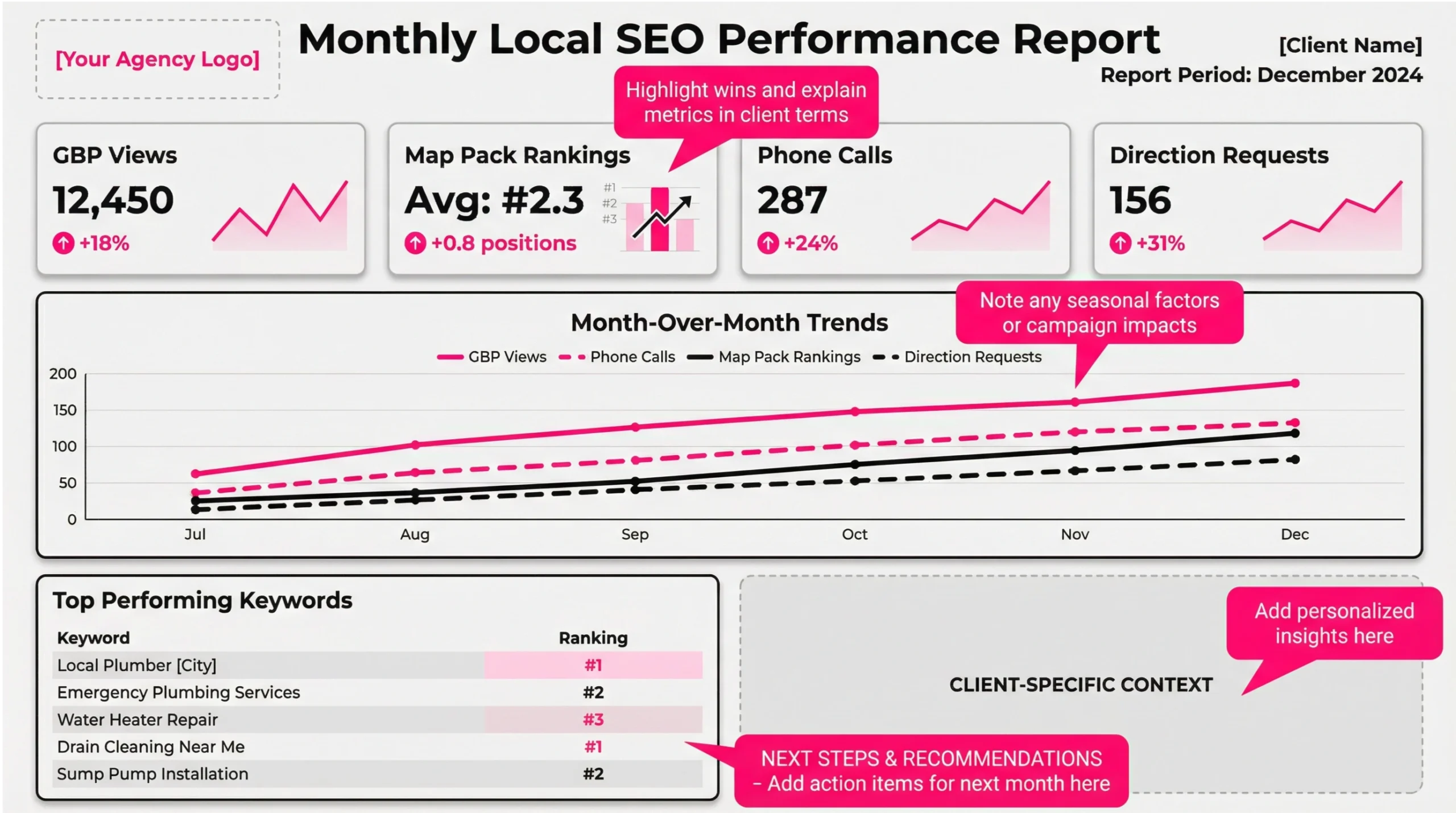
Realistic timelines for local SEO
Local SEO moves faster than national organic campaigns, but it still requires patience. Agencies that set accurate expectations upfront retain clients longer and avoid difficult conversations later.
The general timeline for SEO results is three to six months, according to SEO.com. Local SEO usually falls on the shorter side of this range. This is because its ranking factors are more controllable. Key factors include GBP optimization, citations, and reviews. In contrast, building domain authority relies more on backlinks.
Here is what agencies should communicate to clients at each stage.
Months one to three represent the foundation phase. Work focuses on technical corrections, GBP optimization, citation cleanup, and initial review acquisition. Tangible leads are unlikely during this period. Early results show better rankings for low-competition keywords. There are also more search impressions in GBP Insights and fixes to NAP inconsistencies across directories.
Do not promise Map Pack placement during this phase. Promise progress indicators instead.
Months three to six represent the authority-building phase. With foundational work complete, the focus shifts to content, review velocity, and local link building. Clients should see increased organic traffic, improved rankings for more competitive keywords, and visibility in the Map Pack for some search terms. This is typically when phone calls and form submissions begin increasing noticeably.
Months six and beyond represent the maintenance and growth phase. The business is now positioned to compete for top rankings. Work shifts to defending position, expanding keyword coverage, and continuous review management. Google sees the business as a real local entity when it gets consistent engagement signals. Over time, these results build up.
Timelines vary based on competition. A dentist in a small town with two rivals will grow faster than a personal injury lawyer in a big city with hundreds of firms. Set expectations accordingly during the sales process.
Metrics that matter for local SEO reporting
Not all metrics deserve equal attention. Agencies waste client goodwill by reporting vanity numbers that do not connect to business outcomes. Focus reports on metrics clients actually care about.
Key metrics that should guide every report include:
- Map Pack rankings for target keywords
- GBP profile views and discovery searches
- Calls and direction requests from GBP
- Website visits from local organic search
- Form submissions or other conversion actions
These metrics connect directly to revenue. When a client sees “32 phone calls from your Google listing this month,” they understand value immediately.
Secondary metrics provide context and demonstrate work being done. These include citation accuracy scores, review count and average rating, keyword position changes, and GBP post engagement. Secondary metrics explain why primary metrics are moving. They belong in reports but should not lead the conversation.
Avoid reporting metrics that confuse or mislead. Total website traffic without details, social media followers, and terms like “impressions” confuse most clients. Also, phrases like “DA increased by 3 points” don’t help. If a metric requires explanation to matter, it probably does not belong in a client-facing report.
Businesses in the top three Map Pack positions receive 126% more traffic and 93% more actions compared to those ranked fourth through tenth, according to research compiled by SEOProfy. This statistic helps clients understand why ranking position matters and why the goal is top-three placement, not just “appearing somewhere on the page.”
Structuring client reports
White label partners typically provide reporting templates agencies can rebrand. The key is ensuring reports tell a clear story, not just dump data.
Effective local SEO reports follow a consistent structure.
Start with an executive summary. Two to three sentences covering the most important outcomes this month. Example: “Your GBP received 847 views this month, up 23% from last month. You appeared in the Map Pack for 12 of your 15 target keywords. Phone calls from your listing increased from 18 to 27.”
Follow with primary metrics visualized. Charts or graphs showing trends over time, not just single-month snapshots. Clients want to see direction, not just current state.
Include work completed this month.
- Citations built
- Reviews responded to
- GBP posts published
- On-page optimizations made
This demonstrates ongoing activity and justifies the retainer.
End with next month’s priorities. What will be worked on, what the agency is watching, and any recommendations for the client. This keeps the engagement forward-looking rather than purely retrospective.
Reports should be delivered with a brief call or video walkthrough, not just emailed as attachments. Agencies can use the report to show wins, explain the context, and tackle questions before they turn into concerns.
A verified Google Business Profile receives approximately 200 clicks or interactions per month on average, according to SEOProfy. Use benchmarks like this to contextualize client results. If a client’s GBP is generating 350 interactions monthly, they are outperforming the average. If they are at 80, there is clear room for improvement.
Setting expectations that protect the relationship
Overpromising destroys client relationships faster than underperformance. Agencies that set conservative expectations and overdeliver retain clients. Agencies that promise the moon and fall short churn clients, regardless of whether actual progress was made.
Never guarantee specific rankings. Google’s algorithm considers proximity, which means a business cannot rank first for every searcher in their service area. Rankings also fluctuate based on competitor activity, algorithm updates, and searcher location. Promise effort and process, not outcomes.
Never guarantee timelines for specific positions. “You’ll be in the Map Pack by month three” is a promise you cannot control. “Most clients see Map Pack movement within three to six months” is accurate and defensible.
Be explicit about what local SEO cannot fix. If the client has a reputation problem, such as a 2.8-star rating with multiple negative reviews, local SEO will not solve it. The business needs to address service quality before visibility investments make sense. If the client is in a very competitive market, they should know that results may take longer and need a bigger investment.
Document expectations in the proposal or onboarding materials. When a client complains at month two that they are not ranking first, you can point back to the documented timeline. This protects the agency and reframes the conversation around what was actually promised.
Warning signs of underperformance
Agencies reselling white label services need to monitor whether their fulfillment partner is delivering. Not all providers execute at the same level, and catching problems early prevents client churn.
Watch for these red flags:
- Static or declining GBP impressions after three months.
- No movement on target keywords after 90 days.
- Citation reports with errors that should have been fixed.
- Review velocity that stays the same as before engagement.
- Reports that seem templated and lack client-specific insights.
If these patterns emerge, escalate with the white label partner. Request explanations, audits, or strategy adjustments. If the partner cannot explain what is happening or what they will do differently, consider switching providers before the client relationship deteriorates.
Healthy local SEO engagements show steady, incremental progress. GBP impressions trend upward. Rankings improve for at least some keywords each month. Review counts grow. If nothing is moving after 90 days of active work, something is wrong with either the strategy or the execution.
Start with one client and scale from there
Most agencies overcomplicate the launch. They spend weeks comparing providers, building sales materials, and refining pricing models before closing a single deal. This delays revenue and creates unnecessary friction. The better approach is simpler: pick one client, run an audit, close the retainer, and learn from the real engagement. Everything else, including process refinement, expanded pricing tiers, and additional client acquisition, comes after.
The fastest path to your first local SEO retainer
Reading about white label local SEO is useful. Selling your first retainer is what actually matters.
The fastest path forward is not building a comprehensive service offering, creating elaborate sales decks, or researching every possible white label provider. It is picking one existing client, running an audit, and having the conversation outlined in Section 8.
Choose a client who fits the local SEO profile. They serve customers in a defined geographic area. They have a physical location or service area. They are already ranking poorly for non-branded searches or have a weak Google Business Profile. They trust your agency based on previous work.
Run an audit using your white label partner’s tools or a free tool like BrightLocal’s free GBP audit.
Identify three to five specific gaps, like:
- Incomplete GBP fields
- NAP inconsistencies
- Low review count
- Missing local content
Present the findings. Use the conversation framework from Section 8. Offer a proposal with clear pricing, deliverables, and a three to six month commitment.
One closed deal teaches more than months of preparation.
Choosing a white label partner without analysis paralysis
Agencies often stall at the partner selection stage. They keep comparing providers, ask for demos from five or six companies, and put off launching the service while looking for the “perfect” partner.
Perfect partners do not exist. Good-enough partners do.
Use the criteria from Section 6. Confirm the partner provides branded deliverables, clear SLAs, transparent pricing, and responsive communication. Verify they do not co-brand or contact your clients directly. Ask the pre-signing questions listed earlier.
If a partner meets these baseline requirements, start working with them. You will learn more from one real engagement than from ten sales calls. If the partnership does not work, you can switch. White label relationships are not permanent.
Search Visibility Masters partners with agencies like this. We offer white label local SEO, web design, and Shopify development. All services are under your brand, so your clients see nothing of us. If your agency is looking for partners, chat with Search Visibility Masters Expert. This will help you grasp pricing, onboarding, and deliverables before making any commitments.
Your implementation checklist
Use this checklist to launch white label local SEO services within the next 30 days.
- Identify three to five current clients that match the local SEO profile. Look for those with a specific geographic service area, a physical location, or a defined territory. Also, consider businesses that rely on local customers to find them.
- Select one white label partner using the evaluation criteria from Section 6. Confirm branding, pricing, SLAs, and communication expectations before signing.
- Run audits for your selected clients using your partner’s tools or free alternatives. Document specific gaps in GBP completeness, citation accuracy, review count, and local keyword rankings.
- Prepare a pricing structure with at least two tiers, such as a setup-only option and a monthly retainer. Base your retail pricing on 2-3x your wholesale cost.
- Schedule post-launch conversations with each client within two weeks of their website going live. Use the conversation framework from Section 8 to transition from project delivery to ongoing visibility services.
- Close one retainer before optimizing your sales process. Learn from the real engagement, then refine your pitch, pricing, and positioning based on what actually worked.
- Set a reporting schedule, either monthly or biweekly. Make sure your white label partner can provide branded reports on time.
Recommended next step
Read the Search Visibility Masters guide to evaluating white label local SEO providers before selecting a partner. It covers the specific questions to ask, red flags to avoid, and what to expect from pricing and deliverables across the market.
